Report

- Aaro Lukkari
- Tomás Nogueira
- Marion Lasarroques
- Pierre Keuper
- Waad Zumrawi
- Wiktoria Świder
Acknowledgements
Abstract
Existing outdoor workspaces often lack essential elements that facilitate productivity, such as Wi-Fi, power sockets, comfortable seating, and protection from the weather. These inadequate conditions discourage potential remote workers from adopting outdoor workspaces. In spring 2025, a team of European Project Semester students from different engineering majors and nationalities worked together to address this challenge. Their solution, the “Co-venient” concept, offers a comfortable and productive outdoor workspace for remote workers. The team followed ethical and sustainability principles throughout the design, marketing and prototyping phases, together with Jira for project and teamwork management. Inspired by the shape of palm trees, the proposed solution features adjustable seating and table height, a sustainable energy source, smart integrated light-emitting diode lighting, weather-protective awnings and an aesthetically pleasing design.
Glossary
| Abbreviation | Description |
|---|---|
| BOM | Bill of Materials |
| EPS | European Project Semester |
| ISEP | Instituto Superior de Engenharia do Porto |
| WBS | Work Breakdown Structure |
1. Introduction
1.1 Presentation
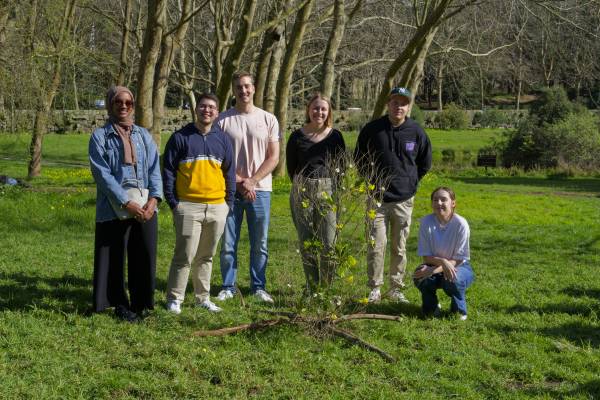
The project is developed by Team 1 of the EPS programme, which offers students with engineering backgrounds a chance to work together on a project at a partner university of their schools. It provides an opportunity for students of different nationalities and study backgrounds to combine their skills and knowledge to produce a unique and realistic solution to a relevant problem. The project is completed under scientific supervision for the duration of one semester. This project outcome was created at ISEP by the team of students present in Table 1.
| Group member | Background | Origin |
|---|---|---|
| Tomás Nogueira | Systems Engineering | PT |
| Aaro Lukkari | Civil Engineering | FI |
| Marion Lasarroques | Industrial and Mechanical Engineering | FR |
| Pierre Keuper | Shipbuilding and Maritime Technology | DE |
| Waad Zumrawi | Industrial Engineering | SD/RO |
| Wiktoria Świder | Information Technology | PL |
1.2 Motivation
EPS
- Tomás: I chose to participate in this program because it offers a unique opportunity to expand my knowledge and develop important skills in an international and collaborative environment.
- Aaro : I am interested in the EPS program to improve my language skills and expand my opportunities. I am also quite certain that I will be working in teams in the future, and this project provides a great opportunity to prepare for that. Also I wanted to expand my world view and live approad!
- Marion : I chose to participate in the European Projects Semester because it was the most rewarding experience for me, both professionally and personally. Working with people from different countries, cultures and academic backgrounds offers the opportunity to discover their ways of thinking and working. It also requires us to develop a great capacity for adaptability to carry out our project.
- Pierre : My motivation for choosing the EPS was firstly the experience of going through all the stages of product development, which will enrich my knowledge and skills for future projects. Secondly, the exciting environment in a foreign country with an international team, which challenges and offers new ways of thinking and managing.
- Waad : For me the European Project Semester offers an amazing and unique opportunity to learn, evolve and meet new very interesting people and get to know not only the Portugese culture, but also cultures from all over the world. Working on a project with teammates from different study fields and countries, as well as different ways of thinking is great and challenging but in a nice way. I am happy to be part of this program!
- Wiktoria : My main reason for choosing EPS was to expand my professional knowledge on project management, as well as gain experience in collaborating in an international group. I view it as a great chance to improve my language skills and my soft skills, which are currently useful on a job market.
Project topic
At the first meeting, 15 project topics were proposed to the group. Each member fo the team selected three topics that interested us the most. By combining the choices, the team came up with three topics : Smartification of Everyday Objects, Smart, Ergonomic Multipurpose Public Equipment and Smartification of Buildings. After sharing the preferences, the team was finally assigned to the Smart, Ergonomic Multipurpose Public Equipment topic.
1.3 Problem
Today, digital technology is everywhere, and more and more people are using digital devices to work or study remotely. To facilitate this, access to a flexible, well-equipped environment outside indoor spaces is necessary. Outdoor work spaces already exist, but they lack all the elements needed to facilitate productivity, such as Wi-Fi, plugs, but also comfortable seating or protection from the elements. This lack of equipment prevents students and remote workers from working in a pleasant, comfortable space.
1.4 Objectives
Co-venient's aim is to create an outdoor workspace that is both comfortable and productive for users. To achieve this, it must contain several elements to ensure an optimal workspace.
Firstly, the space and layout of the work environment. It must be large enough to guarantee a certain level of comfort, and must also be adjustable to enable people to work in the position they want: seated or standing.
Accessibility and comfort are the major criteria for this project, the place must be ergonomic and above all easy to access for all types of people.
Another very important criterion is connectivity, with Wi-Fi access and electrical outlets for recharging various digital devices: phones, computers and tablets.
It is also essential to use renewable resources, so solar panels will be used to power outlets, mechanisms and lights to ensure a certain level of luminosity throughout the day. In keeping with our eco-responsible approach, the space will be designed using quality materials.
Users will be able to choose whether they prefer shady or sunny areas, and where.
Co-venient should be an outdoor workspace that combines comfort, technology and respect for the environment, offering an optimal outdoor working experience.
1.5 Requirements
The requirements were determined with the consumer's perspective in mind. The aim is to provide a solution that satisfies these needs. These requirements cover everything from user experience to addressing everyday necessities. As a user, I want :
- a place where I can work quietly.
- space to work.
- to be able to work outside.
- to have access to Wi-Fi.
- to have sockets to charge my digital devices (telephones, computers, tablets, etc.).
- an easy to access and comfortable location.
- a space that I can adjust as I wish to work in a sitting position as well as in a standing position.
- a place that uses renewable energies.
- to have good lightning.
- a place that uses quality materials.
- a place where I can be in the shade if I wish but also in the sun.
1.6 Functional tests
To ensure the outdoor workspace is compliant with your specifications, a set of tests will be implemented:
UC1 - automatic lighting
- Artificial lighting test: the effectiveness of lighting in the night and in poorer lighting conditions should be assessed.
UC2 - adjustable work surface height
- Adaptability test: confirm the space can be adapted to work in either sitting or standing positions.
- Accessibility test: determine if the designated space is easily accessible for all users including those with reduced mobility.
UC3 - Wi-Fi communication
- Connectivity: It must be possible to connect a device to the internet through the prototype.
UC5 - sustainable energy autonomy
- Renewable energy test: confirm solar panels produce enough electricity to light the space.
UC6 - manually operated awnings for shading and weather protection
- Sun protection test: Verify the space provides you an option of shade or sun according to your needs.
- Shade adjustment test: Check shading solutions are functional and easy to operate.
These testing will help to guarantee an adjustable, functional and durable prototype that meets user's expectations.
1.7 Report Structure
| Chapter | Description |
|---|---|
| 1 - Introduction | Team presentation and description of the topics with the objectives and requirements. |
| 2 - State of the Art | Research and analysis of existing products and projects. |
| 3 - Project Management | Overview of the project management plan. |
| 4 - Marketing Plan | Analysis of our project target and marketing strategy. |
| 5 - Eco-efficiency Measures for Sustainability | Explanation of sustainable aspects through economics, the environment and social issues. |
| 6 - Ethical and Deontological Concerns | Ethical analysis of the project. |
| 7 - Project Development | Explanation of how our project has evolved. |
| 8 - Conclusions | Summary of our project and its future development. |
2. Background and Related Work
2.1 Introduction
The overarching theme of this project is intelligent, ergonomic and multifunctional public furniture. The team interpreted this theme as developing solutions for the lack of outdoor public spaces where people can work or study. The relevance of this topic arises from the increasing trend towards location-independent working. At the same time, people who want to use public places to work or study often face considerable challenges: uncomfortable seating, a lack of power sources, no connection to Wi-Fi and no or inadequate weather protection facilities. This chapter presents the current state of the art - including existing concepts, products and research projects. It also analyses these findings in relation to the objectives of our project.
2.2 Concepts
A workstation is a purpose-built area for work-related activities typically found in offices, at home or in industrial environments. These workstations can range from individual desks to larger, shared areas, depending on their purpose and function. They are usually equipped with ergonomic furniture, digital devices and the necessary tools to increase productivity and comfort. Depending on professional requirements, they can be flexibly adapted to administrative, creative, research-related or technical activities. Modern workplace concepts emphasise efficiency, flexibility and well-being and integrate modular structures, intelligent technologies and sustainable materials.
In today's urbanised world, many people spend a lot of their time indoors, disconnected from nature, especially when working. Yet being outdoors and in contact with the natural environment has great potential to promote physical and mental well-being[Ming Kuo, 2015] [Howard Frumkin, et al., 2017]. Historically, people used to spend significantly more time outdoors. The consequences of constantly spending time in closed, often stressful working environments are not yet fully understood. Contact with nature can improve concentration [Stephen Kaplan, 1995] [Cecilia U. D. Stenfors, et al., 2019], support stress reduction [Roger S. Ulrich, 1984] and increase emotional well-being [Ethan A. McMahan, David Estes and, 2015]. All of these effects have a positive impact on cognitive performance and learning processes. In today's working world, with its high demands on social skills, problem-solving abilities and creativity, spending time outdoors can provide a valuable counterbalance to digital overstimulation [Michiel AJ Kompier, 2006] [Charlotte Petersson Troije, et al., 2021].
Floating workstations, or floating offices, are conceptualized as functional workspace in water, designed for habitation, entertainment, industrial, and commerce purposes on any freshwater or seawater. Floating workstations are used as a structure with buoyance via air-filled, or lightweight materials. New offshore developments are now reaching area in the deep waters as an alternative to land reclamation along the shore line. The floating workstation uses a buoyant foundation to develop a new connection with the marine environment and adapt to different sea levels. It also corresponds to rising sea levels and the desired effect of limited urban land component. Figure 2 displays a floating office.

2.3 Products
Several companies and organizations have already developed approaches to enable co-working in public spaces. One well-known example is so-called ‘smart benches’ such as those offered by Strawberry Energy and Soofa. These use solar energy to provide functions such as Wi-Fi, charging stations for mobile devices and environmental sensors. Even though they cover useful basic functions such as internet access and energy supply, they lack ergonomic working options - in particular adjustable seats or work surfaces that would allow people to work comfortably for longer periods of time. Another approach can be found in urban furniture concepts such as those developed by Include Ltd. These include standing desks or leaning surfaces designed for short meetings or spontaneous outdoor work. Aspects of the mobile working world are also addressed here. However, a complete solution is missing: seating, power connections and WLAN are usually not integrated together in one system, nor can the furniture be customized. In contrast, the concept developed as part of this project takes a more comprehensive approach: the designed co-working workstation for public spaces combines height-adjustable seating and table surfaces, enables both sitting and standing work, offers charging stations and Wi-Fi access as well as ergonomic support. This creates a significantly higher quality of stay. For students, freelancers and small teams in particular, this solution represents an attractive, flexible and technology-friendly alternative to the traditional workplace. Several commercial smart bench models are already available on the market that combine solar energy with modern urban functions such as Wi-Fi, device charging and environmental monitoring. Three particularly relevant examples are presented in more detail below:
Soofa Smart Bench
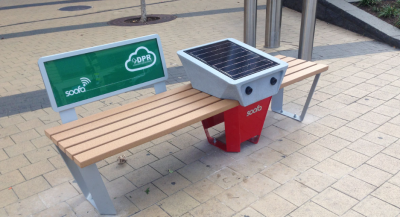
In Figure 3 it is possible to see the Soofa Smart Bench. This solar-powered bench offers free Wi-Fi and phone charging capabilities. It is designed for urban spaces and contributes to smart city initiatives by providing connectivity and sustainable energy use.
Strawberry Smart Bench

In Figure 4 we can see that this advanced bench features solar panels, Wi-Fi hotspots, and charging ports. Additionally, it incorporates environmental sensors that can track weather conditions through trusted third-party providers.
Kuube Smart Bench

A more extensive smart bench solution, Kuube benches, visible in Figure 5, include two separate seating areas. They offer the same core features of solar-powered charging, Wi-Fi, and environmental sensors while also being designed for different urban needs and aesthetics.
Extremis AMAI

AMAi, in Figure 6, is a versatile, modular table for indoor and outdoor use. Its design is based on two A-frames, providing a solid structure. The height-adjustable table top makes it easy to switch from standard to standing height, although with manual external assistance. The system can be customised using various materials and accessories and can be equipped with LED lighting, sockets and sun protection, among other things. By adding further modules, the work area can be extended to accommodate more people.
Each of these smart benches enhances public spaces by combining sustainability with modern technology, improving urban infrastructure, and promoting green energy solutions.
2.4 Projects
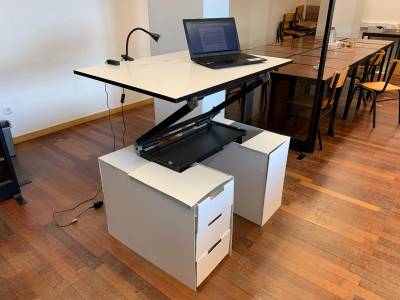
When we looked at the latest EPS projects from previous years we found a project with a similar idea concerning an adjustable table. The name of the project was Amplea. This was done by team 1 during the year 2022/2023. They came up with the idea of a modern piece of furniture that can be used as a kitchen, a dining table or an office desk, as you can see in Figure 7. The table was composed of several parts. One part was a kitchen worktop with cooking plates, tap and sink, as well as sockets and lights. This part was between 2 cabinets. Finally, there was an extendable table that could be pulled out to form a dining table or desk. You could also adjust the height of the whole unit.

Another project that we found was done on EPS by team 3 during the year 2020/2021. Visible in Figure 8, the FreeDesk was made during the pandemic. The team’s main goal was to create a more flexible and autonomous work environment for people who were working remotely. It could be used as a bench, a sitting desk or even as a standing desk.
2.5 Comparative Analysis
This analysis compares the Co-venient Smart Bench with the competitors Strawberrye, Kuube and extremis AMAi in Table 3. It focuses on key features, energy efficiency, ergonomics and value proposition.
| Feature | Co‑venient | StrawberryE Smart Bench 2 | Kuube Smart Bench | Extremis AMAi Bench |
|---|---|---|---|---|
| Solar Power Capacity | 1 070 W array | 80 W panel | 480 W array | Not available |
| Battery Storage | 1.5 kWh (3 × 40 Ah LiFePO₄) | ~1 kWh (80 Ah) | 2.7 kWh (224 Ah AGM) | Not available |
| Charging Options | 5 ports (3 USB‑C PD, 2 AC for laptops) | 2‑4 USB, 2 Qi wireless, no laptop charging | 4 ports (2 USB, 2 Qi wireless), no laptop charging | Not available |
| Energy Independence | High, good for all‑day use | Limited, short runtime without sun | Moderate, daily public use | Not applicable |
| Sustainability | Fully solar‑powered, efficient design, recyclable materials | Solar‑powered but smaller capacity | Solar‑powered with recyclable materials | No integrated energy system |
| Seating Comfort | Comfortable, adjustable seat‑back support | Fixed seating, basic comfort | Sheltered eight‑seater with roof | Modular, 2 optional seatings for long use |
| Adjustable Table | Motorised height adjustment | No Table | No Table | Adjustable height, multi‑use |
| User‑Friendliness | Made for coworking & long sessions | Quick breaks & device charging | Community hub with Wi‑Fi hotspot | Flexible public use |
| Weather Protection | Weather‑resistant, adjustable awnings | Weather‑resistant, offers no protection | Weather‑resistant, offers little weather protection | Weather‑resistant, shading modules available, no rain protection |
| Primary Purpose | Smart coworking bench | Public seating with quick charging | Public seating with quick charging possibility | Multi‑purpose modular bench |
| Target Users | Remote workers, students, freelancers | General public, casual users | City dwellers, tourists | Public spaces, events, gatherings, private gastronomy |
| Tech Integration | IoT monitoring, Wi‑Fi, charging, adjustable seating and desk | Charging, LTE Wi‑Fi, sensors | 4G hotspot, sensors, LEDs | No smart tech integration |
| Estimated Costs (€) | ~9000 | 1800 | 6500 | 6200 |
Key Insights & Conclusion The StrawberryE Smart Bench 2 offers a cost-effective solution that is primarily designed for short-term use in public spaces. With an integrated solar panel and a Wi-Fi hotspot, it enables basic functions such as charging devices and internet access. However, due to the limited photovoltaic power and low battery capacity, continuous operation is not possible, meaning that true energy self-sufficiency cannot be achieved. This bench is therefore particularly suitable for occasional users who want to take a short break, charge their device quickly or access the internet temporarily.
The Extremis AMAi Bench is characterised by an ergonomic, modular architecture that supports both social interaction and professional meetings. With its adjustable height and variable seating configuration, it offers a high level of comfort for users. However, this model does not have an integrated power supply or connectivity. The AMAi Bench is therefore more of a high-quality piece of design furniture with a flexible seating solution, but not a specialised smart coworking platform.
The Kuube Smart Bench represents a further development in the field of intelligent street furniture. It combines solar operation with various urban functions such as WLAN, USB charging stations and integrated environmental sensors. Kuube offers a small protected seating area with a canopy and is particularly suitable for highly frequented public places. However, the bench lacks adjustable work surfaces or a truly ergonomic design, which limits the amount of time you can spend working on it.
The Co-venient Bench combines the main advantages of all the systems mentioned and adds additional functions. It combines the solar-powered infrastructure and connectivity features of the StrawberryE Smart Bench 2 and the Kuube Bench with a superior ergonomic seating design, as indicated by the AMAi Bench. In addition, Co-Venient has a motorised, height-adjustable work surface, increased energy capacity (1,070 W photovoltaic, 1.5 kWh LiFePO₄), multiple USB-C power delivery and AC sockets for charging laptops.
2.6 Summary
The analysis of current height-adjustable workstations and smart outdoor furniture confirms the increasing need for outdoor working environments that enable both connectivity and contact with nature for professionals. With growing demands for flexible and inspiring workspaces, smart coworking infrastructures are proving to be a winning combination of functionality, sustainability and comfort, boosting productivity while promoting wellbeing.
The solutions currently available on the market, such as solar-powered benches, modular seating groups or height-adjustable tables, only cover individual aspects of this need. However, an analysis of the specialist literature and a benchmark comparison reveal an existing gap: There is a lack of a fully integrated concept that combines energy self-sufficiency, ergonomic adaptability and seamless connectivity in a single system.
The project team therefore decided to develop an ergonomic, multifunctional outdoor workstation that ensures comfort, reliable power supply and continuous data access. At the heart of the design are highly efficient photovoltaic modules that power height-adjustable seating and work surfaces, multiple charging ports, Wi-Fi coverage, task lighting and weatherproof materials for all year use.
By combining modern energy management and user-orientated design, the system offers genuine independence and flexibility, making it an attractive alternative to conventional coworking spaces.
The following chapter presents the chosen project management approach and explains the weekly work plan, key milestones and the progress of the project to date.
3. Project Management
This chapter deals with project management to ensure the organization of the project, addressing scope, time, cost, quality, people, communications, risk, procurement, stakeholders, project plan, sprint outcomes and sprint evaluations.
3.1 Scope
Project scope describes the fundamental steps to ensure effective development and serves to clarify and guide along the way. As indicated in Figure 9, the project is implemented in several areas: project management, design and assembly. By decomposing the project, each segment is treated in a systematic and planned manner.

After identifying the project deliverables, it is essential to distribute them over time in order to organize the project. In Figure 10 it is possible to see this distribution in a high-level gantt chart.

There are some red lines on the gantt chart because some dates overlap.
3.2 Time
Below, in Table 4, is the list of the milestones for the project. The project duration is 4 months, starting in March and ending in June.
| Task | Proposed date | Effective date |
|---|---|---|
| Choose the project proposal | 2025-03-01 | 2025-02-28 |
| System Diagrams & Structural Drafts | 2025-03-12 | 2025-03-12 and final version at 2025-05-28 |
| Project Backlog, Global Sprint Plan, Initial Sprint Plan and Release Gantt Chart | 2025-03-15 | 2025-03-15 |
| List of Components and Materials | 2025-03-19 | 2025-03-19 |
| System Schematics & Structural Drawings and cardboard scale model | 2025-03-26 | 2025-03-26 |
| Interim Report | 2025-04-06 | 2025-04-06 |
| Interim Presentation | 2025-04-10 | 2025-04-10 |
| 3D model video | 2025-04-15 | 2025-04-15 and the final version at 2025-05-28 |
| Final List of Materials | 2025-04-29 | 2025-04-29 |
| Refined Interim Report | 2025-05-02 | 2025-05-02 |
| Packaging Solution | 2025-05-14 | 2025-05-14 |
| Functional Tests | 2025-05-28 | 2025-05-28 |
| Final Report, Presentation, Video, Paper, Poster and Manual | 2025-06-15 | 2025-06-15 |
| Final Presentation | 2025-06-18 | 2025-06-18 |
| Refined Final Report | 2025-06-25 | 2025-06-22 |
3.3 Cost
Certain factors need to be taken into account when talking about cost. In Table 5 it is show the costs in a project like this.
| Type of cost | Description | Price |
|---|---|---|
| Mechanical engineer salary | Salary of 2 engineers for 6 months of work | 2 x 6 x 2000 € |
| Civil engineer salary | Salary of 2 engineers for 6 months of work | 2 x 6 x 2000 € |
| Project manager salary | Salary of one project manager for 6 months of work | 6 x 2500 € |
| Quality manager salary | Salary of one quality manager for 6 months of work | 6 x 1500 € |
| Facilities | Workplace in 6 months consider all expenses | 6 x 1000 € |
| Prototype | Price of components used in the construction of the prototype | 100 € |
| Tools | Tools used to build the prototype | 500 € |
All of these costs are real in a project outside of the university. If the project were carried out in a company, the total cost would be 78 600€ (adding salaries, expenses on facilities, the prototype and all the tools needed to build it). In this specific case, the only cost would be €100 for the prototype because the employees are students, the facilities belong to the university and the tools are provided by ISEP. Another relevant issue is the price of all the product components. Table 6 displays the price of all components as well as where to buy them.
| Total | 6.356,00 € |
The layout starts with two 535 W Jinko modules sending steady power into a Victron SmartSolar 150/100 MPPT. This controller was picked because its 150 V limit safely covers the panels 100 V open‑circuit and its 100 A output is large enough for future growth. Charging is done on a 12 V rail, so three 40 Ah LiFePO₄ packs sit in parallel, that spreads current evenly, gives 1.5 kWh usable energy, and stays within each battery’s built‑in BMS limits. Low‑voltage loads—USB‑C hub, MikroTik router, ESP32 board, DHT22 sensor, LED strip, and 12 V linear actuators—tap the bus directly, avoiding inverter losses. Items that still need mains voltage run from a Phoenix 12/500 pure‑sine inverter, its 400 W continuous rating easily covers two laptop chargers yet draws only 10 W idle. A Victron Lynx Distributor keeps every branch fuse in one place while a 500 A SmartShunt logs real‑time current and state‑of‑charge. Together these parts match on voltage, leave head‑room on current, and recharge fully after roughly four peak‑sun hours, giving a compact, efficient, and protected off‑grid system.
3.4 Quality
This project can be divide in two different sections: co-venient quality and documentation quality.
3.4.1 Co-venient quality
The metrics aproach here are about physical product itself:
- Durability and material quality - the prototype needs to pass all the load and stress simulations
- Funcionality - the prototype needs to have all the features described in the scope of the project
- Environmental impact - all materials must be from Portugal or Spain, helping local producers and also reducing the emission of polluting gases due to the short journey to deliver the materials
Table 7 illustrates all specified metrics in checklist format.
| Metric | Checkpoint | Met the criteria? (Yes/No) |
|---|---|---|
| Durability and material quality | Structural components passed all load and stress simulations (the seat must pass a test with a load of 6000 N and the table must pass a test with a load of 2000 N) | Yes |
| Durability and material quality | No visible damage on the final product | Yes |
| Funcionality | The electrical components function correctly under normal use (the components work at the usual temperatures in mainland Portugal (between 4ºC and 35ºC) with daily for 8 hours using 3 USB-C for phones/laptops and schuko sockets for 2 laptops) | Yes |
| Funcionality | All mechanical parts operate as intended (power is supplied to the system by solar panels, the lights work, the awnings operate manually and the benches and tables move up and down using buttons) | Yes |
3.4.2 Documentation quality
The metrics show below consider all the documentation required for the project:
- Consistency - all documents should have the same font size and font type
- Clarity - all documents must be written with sentences for a higher level of education
- Visual Appeal - all documents must have the ISEP logo, the project logo and follow the color pattern chosen for the entire project
These guidelines play a vital role when we talk about the quality of the entire project from prototype to management of all stakeholders. Regarding load and stress simulations, these are detailed in chapter that talk about project development.
3.5 People
In every project, the stakeholders play a vital role, each with varying degrees of influence and significance. Table 8 shows the stakeholders and their roles in the project. In the stakeholders management chapter, it's illustrate the influence and the power of these stakeholders.
| Stakeholder | Role |
|---|---|
| Team members | Owners |
| Supervisors | Supervising the project development |
| Professor Benedita Malheiro | EPS coordinator |
| Suppliers | Providing the components |
| Competitors | External influence |
| Customers | Buyers |
3.6 Communications
Communication is essential to achieving all the project's objectives. For that reason, the team communicates via a WhatsApp group, which facilitates real-time updates. The team used Microsoft Teams to organize important documents, while Jira helped track individual's work, as well as team’s work. Weekly meetings with supervisors were organized to update them about the project's status. Before that weekly meeting, the team prepared the agenda to ensure that all the important information was transmitted. Table 9 shows how the team will communicate with each stakeholder.
| Stakeholders | Channel | How many times | |
|---|---|---|---|
| Team members | WhatsApp and in person | Whenever necessary | Talk about project development |
| Supervisors | In-person meeting | Weekly | To discuss the work developed in the sprint |
| Professor Benedita Malheiro | In-person meeting | Weekly | To discuss the work developed in the sprint |
| Suppliers | - | - | Since it is just a university project, there is no real communication with this stakeholder |
| Competitors | - | - | Since it is just a university project, there is no real communication with this stakeholder |
| Customers | - | - | Since it is just a university project, there is no real communication with this stakeholder |
3.7 Risk
Risk management is a approach to prevent and addressing potential challenges that can appear during the project. Each risk is evaluated based on its probability of occurrence and potential impact on the project. Figure 11 shows a 5×5 Risk Matrix that is going to be used to analyse the risks in this project.
Probability of occurence:
- 5: ]80%, 100%]
- 4: ]60%, 80%]
- 3: ]40%, 60%]
- 2: ]20%, 40%]
- 1: [0%, 20%]
Potential impact:
- 5: Spend more than 1000€ with that risk
- 4: Spend more than 750€ with that risk
- 3: Spend more than 500€ with that risk
- 2: Spend more than 250€ with that risk
- 1: Spend more than 0€ with that risk

The Table 10 illustrates several risks in the project, the response to it and the way these risks are going to be handle. The way the group will control these risks depends on the risk level they present [Patricia Guevara, 2024] :
- 1-4: Acceptable (no further action may be needed and maintaining control measures is encouraged)
- 5-9: Adequate (may be considered for further analysis)
- 10-16: Tolerable (must be reviewed in a timely manner to carry out improvement strategies)
- 17-25: Unacceptable (must implement cease in activities and endorse for immediate action)
| Risk | Probability | Impact | Risk level | Response | Risk handling |
|---|---|---|---|---|---|
| Member does not want to work (refusing to perform tasks assigned to you or exceeding the stipulated deadlines) | 3 | 4 | 12 - Tolerable | Mitigate | The group needs to be honest |
| Technical challenges (lack of internet or computer problems) | 3 | 3 | 9 - Adequate | Mitigate | Be aware of what it is need to do the project |
| Supplier delays | 2 | 2 | 4 - Acceptable | Transfer | The group can choose a different supplier if there is a problem with delivery times |
| Budget constraints (not meeting the values initially established) | 4 | 5 | 20 - Unacceptable | Avoid | Change the design to have less features or by cheaper components |
| Not respecting deadlines | 2 | 3 | 6 - Adequate | Mitigate | Be aware of the deadlines and be aware of that during the sprint plan |
| Product does not work well (the product does not meet the requirements initially defined) | 2 | 4 | 8 - Adequate | Mitigate | Understand the project and know what the project requires to be done |
| Copyright (excessive use of AI, use of information without using source) | 3 | 4 | 12 - Tolerable | Mitigate | The team needs to be aware of all legal issues related to the project |
3.8 Procurement
To accomplish this project and its outlined deliverables, a proof of concept will be developed in the form of a prototype for 100 €. Due to limited funding, the team decided to build most of the product themselves. The first step was to create a detailed Bill of Materials (BOM) describing all the components needed for the prototype, shown in Table 11. The main purpose of this was to define the most cost-effective option for each component. After that, it was time to assemble everything and create the prototype.
In reality, the prototype ended up being made with existing material at the university, so the final list of materials used is found in table 12.
| Component | Quantity |
|---|---|
| ESP32 | 1 |
| Breadboard | 1 |
| Super glue 3 | 1 |
| Contact glue | 1 |
| Epoxy glue | 1 |
| Pipe 20 mm | 3 |
| Pipe 25 mm | 3 |
| Pipe 32 mm | 1 |
| Wood self-adhesive paper | 1 |
| Green cardboard | 2 |
| PVC plate | 4 |
| Electrical wires | 21 |
| BBQ sticks | 5 |
| Solar panel | 1 |
| Adjustable plastic clamps | 1 |
| TSL2561 luminosity sensor module | 1 |
| GY-21 HTU21D humidity / temperature sensor module | 1 |
Table 13 shows the list of materials with an alternative supplier for almost all materials. It is worth noting that materials that do not have an alternative supplier make the project risky since, if the supplier does not have the material, it is not possible to assemble the product. Another important fact is that all materials come from Portugal or Spain and the materials used are recyclable.
| Total | 6356,00 € |
There are materials that are found in different quantities when changing suppliers, as their dimensions are often different from those of the first choice, so the team has to choose a larger quantity. Another fact to highlight is that if the project is made using materials from alternative suppliers, the product becomes considerably more expensive since the price of the raw material increases.
3.9 Stakeholders Management
Stakeholder management is a fundamental aspect in attaining project success since it ensures the satisfaction and involvement of all stakeholders. In Table 14, the main stakeholders in this project are enumerated, categorized according to their level of interest and power.
| Stakeholders | Power | Interest |
|---|---|---|
| Team members | High | High |
| Supervisors | High | High |
| Professor Benedita Malheiro | High | High |
| Suppliers | High | Medium |
| Competitors | Low | Low |
| Customers | Medium | High |
All the stakeholders do have a different influence on the project. The team therefore has to alter their communication with them so that they do remain interested. For example, the competitors have a minimal impact in the project while the supervisors and the team members will have to be tightly controlled through extensive communication such as meetings, listening to their requirement and feedback, creating a trust relationship. All these can be plotted, taking a look at Figure 12, which it is simpler to show the role and impact of each stakeholder.

Table 15 presents the specific way of dealing with each stakeholder.
| Stakeholders | How to manage |
|---|---|
| Team members | Hold several meetings to make sure everyone knows what to do and the status of the project |
| Supervisors | Hold a sprint meeting to present the work developed in that same sprint |
| Professor Benedita Malheiro | As well as the supervisory team, make it clear how the project is being developed and what is being done |
| Suppliers | Regular communication with suppliers is necessary, with clear and fair negotiations. |
| Competitors | As a minimal impact stakeholder, the team needs to monitor with minimal attention |
| Customers | Frequent and transparent communication with customers is necessary, given the high interest |
3.10 Project Plan
Table 16 shows the global sprint plan with the main goal of each sprint.
| Sprint | Start | Finish | Main goal |
|---|---|---|---|
| 1 | February, 27 | March, 5 | Choose a topic |
| 2 | March, 6 | March, 12 | Do initial sketches and black box diagram |
| 3 | March, 13 | March, 19 | Do the list of components and materials |
| 4 | March, 20 | March, 26 | Do detailed system schematics and structural drawings |
| 5 | March, 27 | April, 2 | Do the design of the logo and start to choose the materials |
| 6 | April, 3 | April, 9 | Do the interim presentation |
| 7 | April, 10 | April, 16 | Upload the final 3D modal video |
| 8 | April, 24 | April, 30 | Upload the final list of materials |
| 9 | May, 8 | May, 14 | Upload packing solution |
| 10 | May, 15 | May, 21 | Understand how to do functional tests and try do some |
| 11 | May, 22 | May, 28 | Upload the results of the functional tests |
| 12 | May, 29 | June, 4 | Do the first version of the video. Finish the development of the manual |
| 13 | June, 5 | June, 11 | Finish the video |
| 14 | June, 12 | June, 18 | Upload the final report, presentation, video, paper, poster and manual |
| 15 | June, 19 | June, 25 | Refine everything and bring typical food |
The project backlog in Table 17 illustrates all relevant tasks of the project.
| PBI | Title | Status |
|---|---|---|
| A | Define project | Done |
| B | Global sprint plan | Done |
| C | Gantt chart | Done |
| D | Research | Done |
| E | State of the art | Done |
| F | System Diagrams & Structural Drafts | Done |
| G | First list of Components and Materials | Done |
| H | System Schematics & Structural Drawings | Done |
| I | Design | Done |
| J | Cardboard scale model | Done |
| K | Interim Report and Presentation | Done |
| L | 3D model video | Done |
| M | List of Materials | Done |
| N | Packaging solution | Done |
| O | Functional Tests | Done |
| P | Final Report | Done |
| Q | Presentation | Done |
| R | Video | Done |
| S | Paper | Done |
| T | Poster | Done |
| U | Manual | Done |
| V | Upload | Done |
| W | Prototype | Done |
| X | Change the interim report | Done |
| Y | List of materials - prototype | Done |
| Z | Load and stress simulations | Done |
Table 18 shows the result of the sprint planning sessions.
| Sprint | Task | Duration (d) | Responsible | Involved |
|---|---|---|---|---|
| 1 | A | 2 | All | All |
| 2 | B | 1 | All | All |
| 2 | C | 2 | Tomás | Tomás |
| 2 | D | 3 | All | All |
| 3 | E | 3 | All | All |
| 3 | F | 3 | All | All |
| 3 | G | 2 | All | All |
| 4 | H | 2 | Tomás and Aaro | Tomás and Aaro |
| 4 | I | 4 | Aaro, Waad and Marion | Aaro, Waad and Marion |
| 4 | J | 1 | All | All |
| 5 | K | 6 | All | All |
| 6 | K | 5 | All | All |
| 6 | L | 5 | Waad | Waad |
| 7 | M | 3 | Aaro and Pierre | Aaro and Pierre |
| 7 | X | 4 | All | All |
| 8 | N | 3 | Waad | Waad |
| 8 | X | 3 | All | All |
| 8 | M | 2 | Aaro and Pierre | Aaro and Pierre |
| 9 | M | 3 | Pierre | Pierre |
| 9 | Y | 2 | Tomás | Tomás |
| 9 | Z | 3 | Waad and Marion | Waad and Marion |
| 10 | S | 2 | Tomás and Aaro | Tomás and Aaro |
| 10 | T | 1 | Wiktoria | Wiktoria |
| 10 | Z | 3 | Waad and Marion | Waad and Marion |
| 10 | W | 1 | Tomás, Aaro, Pierre and Wiktoria | Tomás, Aaro, Pierre and Wiktoria |
| 11 | W | 4 | Tomás, Aaro, Pierre and Wiktoria | Tomás, Aaro, Pierre and Wiktoria |
| 11 | U | 2 | Marion | Marion |
| 11 | O | 1 | Marion | Marion |
| 11 | M | 3 | Pierre | Pierre |
| 11 | S | 1 | Tomás | Tomás |
| 11 | T | 1 | Wiktoria | Wiktoria |
| 11 | Z | 3 | Waad and Marion | Waad and Marion |
| 12 | S | 1 | Tomás | All |
| 12 | U | 2 | Marion | Marion |
| 12 | M | 3 | Pierre | Pierre |
| 12 | T | 1 | Wiktoria | Wiktoria |
| 12 | Z | 3 | Waad and Marion | Waad and Marion |
| 12 | R | 3 | Pierre | Pierre |
| 12 | P | 4 | All | All |
| 12 | Q | 4 | All | All |
| 13 | S | 1 | Tomás | Tomás |
| 13 | U | 2 | Marion | Marion |
| 13 | Z | 3 | Waad and Marion | Waad and Marion |
| 13 | R | 3 | Pierre | Pierre |
| 13 | P | 4 | All | All |
| 13 | Q | 4 | All | All |
| 14 | R | 3 | Pierre | Pierre |
| 14 | P | 4 | All | All |
| 14 | Q | 4 | All | All |
| 14 | V | 4 | All | All |
Table 19 expresses the item status in the end of each sprint review.
| Sprint | PBI | Duration | Responsible | Involved | Status |
|---|---|---|---|---|---|
| 1 | A | 2 | All | All | Done |
| 2 | B | 1 | All | All | Done |
| 2 | C | 2 | Tomás | Tomás | Done |
| 2 | D | 3 | All | All | Done |
| 3 | E | 3 | All | All | Done |
| 3 | F | 3 | All | All | Done |
| 3 | G | 2 | All | All | Done |
| 4 | H | 2 | Tomás and Aaro | Tomás and Aaro | Done |
| 4 | I | 4 | Aaro, Waad and Marion | Aaro, Waad and Marion | Done |
| 4 | J | 1 | All | All | Done |
| 5 | K | 6 | All | All | Ongoing |
| 6 | K | 5 | All | All | Done |
| 6 | L | 5 | Waad | Waad | Done |
| 7 | M | 3 | Aaro and Pierre | Aaro and Pierre | Done |
| 7 | X | 4 | All | All | Done |
| 8 | N | 3 | Waad | Waad | Done |
| 8 | X | 3 | All | All | Done |
| 8 | M | 2 | Aaro and Pierre | Aaro and Pierre | Ongoing |
| 9 | M | 3 | Pierre | Pierre | Ongoing |
| 9 | Y | 2 | Tomás | Tomás | Done |
| 9 | Z | 3 | Waad and Marion | Waad and Marion | Ongoing |
| 10 | S | 2 | Tomás and Aaro | Tomás and Aaro | Ongoing |
| 10 | T | 1 | Wiktoria | Wiktoria | Ongoing |
| 10 | Z | 3 | Waad and Marion | Waad and Marion | Ongoing |
| 10 | W | 1 | Tomás, Aaro, Pierre and Wiktoria | Tomás, Aaro, Pierre and Wiktoria | Ongoing |
| 11 | W | 4 | Tomás, Aaro, Pierre and Wiktoria | Tomás, Aaro, Pierre and Wiktoria | Done |
| 11 | U | 2 | Marion | Marion | Ongoing |
| 11 | O | 1 | Marion | Marion | Done |
| 11 | M | 3 | Pierre | Pierre | Ongoing |
| 11 | S | 1 | Tomás | Tomás | Ongoing |
| 11 | T | 1 | Wiktoria | Wiktoria | Ongoing |
| 11 | Z | 3 | Waad and Marion | Waad and Marion | Ongoing |
| 12 | S | 1 | Tomás | All | Ongoing |
| 12 | U | 2 | Marion | Marion | Ongoing |
| 12 | M | 3 | Pierre | Pierre | Done |
| 12 | T | 1 | Wiktoria | Wiktoria | Done |
| 12 | Z | 3 | Waad and Marion | Waad and Marion | Ongoing |
| 12 | R | 3 | Pierre | Pierre | Ongoing |
| 12 | P | 4 | All | All | Ongoing |
| 12 | Q | 4 | All | All | Ongoing |
| 13 | S | 1 | Tomás | Tomás | Done |
| 13 | U | 2 | Marion | Marion | Done |
| 13 | Z | 3 | Waad and Marion | Waad and Marion | Done |
| 13 | R | 3 | Pierre | Pierre | Ongoing |
| 13 | P | 4 | All | All | Ongoing |
| 13 | Q | 4 | All | All | Ongoing |
| 14 | R | 3 | Pierre | Pierre | Done |
| 14 | P | 4 | All | All | Done |
| 14 | Q | 4 | All | All | Done |
| 14 | V | 4 | All | All | Done |
An extended gantt chart is availabe in https://eps-team1-summer-2025.atlassian.net/jira/software/projects/EPSTEAM1/boards/1/timeline.
3.11 Sprint Outcomes
The team used Jira to track every sprint. The summaries of the sprints are present from Table 20 to Table y. After sprint 2, a burndown chart is associated with each sprint outcome illustrated from Figure 13 to Figure y.
| Product Backlog Item | Assignee | Planned Effort [h] | Status |
|---|---|---|---|
| Research | All | - | Done |
| List of components and materials (first version) | All | - | Done |
| Business model canvas | All | - | Done |
| Gantt chart | Tomás | - | Done |

In this sprint there were no time estimates, so the graph did not have values different from 0 in Figure 13.
| Product Backlog Item | Assignee | Planned Effort [h] | Status |
|---|---|---|---|
| System schematics and structural drawings | Tomás and Aaro | 32 | Done |
| Minute and week report | Wiktoria and Tomás | 0.5 | Done |
| List of requirements | Marion | 1 | Done |
| Comparative analysis | Pierre | 2 | Done |
| Flyer | Wiktoria | 8 | Done |
| Cardboard model | All | 8 | Done |

In this sprint, time estimates were only made after the sprint had started, so there was no guideline. However, almost all of the planned work was carried out, as can be seen in Figure 14.
| Product Backlog Item | Assignee | Planned Effort [h] | Status |
|---|---|---|---|
| Interim report | Tomás, Aaro, Wiktoria, Marion and Pierre | 35 | Ongoing |
| Interim presentation | Wiktoria | 3 | Ongoing |
| 3D model video | Waad | 13 | Ongoing |
| List of components and materials | Pierre and Aaro | 4 | Ongoing |
| Minute and week report | Wiktoria | 0.5 | Done |

In this sprint, time estimates were made before the sprint began, however, halfway through the sprint, the expected work hours for some tasks on April 1st were changed, which led to a substantial increase in work time that prevented the completion of almost all tasks. All of this is visible in Figure 15.
| Product Backlog Item | Assignee | Planned Effort [h] | Status |
|---|---|---|---|
| Interim report | Tomás, Aaro, Wiktoria, Marion and Pierre | 35 | Done |
| Interim presentation | Wiktoria | 3 | Done |
| 3D model video | Waad | 13 | Ongoing |
| List of components and materials | Pierre and Aaro | 4 | Ongoing |
| Minute and week report | Wiktoria | 0.5 | Done |

In this sprint the work was done over time and all estimates were made before the start of the sprint. All of this is visible in Figure 16.
| Product Backlog Item | Assignee | Planned Effort [h] | Status |
|---|---|---|---|
| Refined interim report | All | 35 | Ongoing |
| Interim presentation | Wiktoria | 3 | Done |
| Load and stress simulations | Waad and Marion | 5 | Ongoing |
| 3D model video | Waad | 13 | Done |
| List of components and materials | Pierre and Aaro | 4 | Ongoing |
| Minute and week report | Wiktoria | 0.5 | Done |

In image 17 it is visible that in sprint 7 the group worked consistently over time, however, the group was unable to complete the work assigned for this same sprint.
| Product Backlog Item | Assignee | Planned Effort [h] | Status |
|---|---|---|---|
| Refined interim report | All | 35 | Done |
| List of materials for the prototype | Tomás | 8 | Ongoing |
| Draft of the leaflet | Wiktoria | 5 | Ongoing |
| Draft of the poster | Wiktoria | 5 | Ongoing |
| Start to prepare load and stress simulations | Marion | 5 | Ongoing |
| Minute and week report | Wiktoria | 0.5 | Done |
| Packaging solution (start) | Waad | 5 | Done |
| List of materials-systems | Pierre | 8 | Done |

This sprint was shorter and from then on the burndown chart ends earlier than expected (all sprints are scheduled to last one week), as seen in image 18.
| Product Backlog Item | Assignee | Planned Effort [h] | Status |
|---|---|---|---|
| List of materials for the prototype | Tomás | 8 | Done |
| Draft of the leaflet | Wiktoria | 5 | Ongoing |
| Draft of the poster | Wiktoria | 5 | Ongoing |
| Finish load and stress simulations | Marion | 5 | Ongoing |
| Minute and week report | Wiktoria | 0.5 | Ongoing |
| Paper-introduction | Tomás | 4 | Done |
| Paper-preliminary studies | Aaro | 5 | Done |
| Marketing chapter | Aaro | 3 | Ongoing |

This sprint was also shorter, lasting only 4 days, but the work was being developed during the sprint and all the time estimates for each task were made before the sprint began. All this information is present in image 19.
| Product Backlog Item | Assignee | Planned Effort [h] | Status |
|---|---|---|---|
| Draft of the leaflet | Wiktoria | 5 | Done |
| Draft of the poster | Wiktoria | 5 | Done |
| Finish load and stress simulations | Marion and Waad | 5 | Ongoing |
| Minute and week report (9th week) | Wiktoria | 0.5 | Done |
| Minute and week report (10th week) | Tomás | 0.5 | Done |
| Marketing chapter | Aaro | 3 | Ongoing |
| Manual (start) | Marion | 8 | Ongoing |
| Finish the leaflet | Wiktoria | 3 | Ongoing |
| Finish the poster | Wiktoria | 3 | Ongoing |
| Refined list of materials | Pierre | 5 | Ongoing |
| Paper-proposed solution | Tomás | 5 | Ongoing |
| Final design and 3d model video | Waad | 6 | Ongoing |
| Assemble the prototype | Tomás, Aaro, Pierre and Wiktoria | 16 | Ongoing |

In this sprint, the team found it very difficult to develop the work that was supposed to be done and many tasks were added throughout the sprint, which caused a very atypical burndown chart, as can be seen in figure 20.
| Product Backlog Item | Assignee | Planned Effort [h] | Status |
|---|---|---|---|
| Finish load and stress simulations | Marion and Waad | 5 | Ongoing |
| Minute and week report | Wiktoria | 0.5 | Done |
| Marketing chapter | Aaro | 3 | Ongoing |
| Manual (start) | Marion | 8 | Done |
| Finish the leaflet | Wiktoria | 3 | Ongoing |
| Finish the poster | Wiktoria | 3 | Ongoing |
| Refined list of materials | Pierre | 5 | Ongoing |
| Paper-proposed solution | Tomás | 5 | Done |
| Paper-prototype development | Tomás | 5 | Ongoing |
| Paper-conclusion | Tomás | 3 | Done |
| Paper-review | All | 5 | Ongoing |
| Final design and 3d model video | Waad | 6 | Done |
| Assemble the prototype | Tomás, Aaro, Pierre and Wiktoria | 16 | Done |

In this sprint, the team worked really hard to develop the work that was supposed to be done, which caused a good sprint, as can be seen in figure 21.
| Product Backlog Item | Assignee | Planned Effort [h] | Status |
|---|---|---|---|
| Finish load and stress simulations | Marion and Waad | 5 | Ongoing |
| Minute and week report | Wiktoria | 0.5 | Done |
| Marketing chapter | Aaro | 3 | Done |
| Finish the leaflet | Wiktoria | 3 | Done |
| Finish the poster | Wiktoria | 3 | Done |
| Refined list of materials | Pierre | 5 | Ongoing |
| Paper-prototype development | Tomás | 5 | Done |
| Paper-review | All | 5 | Done |
| Refined load and stress simulations | Waad | 4 | Ongoing |
| Start the presentation | All | 6 | Done |
| Finish the user manual and assembly manual | Marion | 10 | Ongoing |
| Start the video | Pierre | 16 | Ongoing |

In this sprint the team worked well, leaving only a few tasks to be done, as can be seen in figure 22.
| Product Backlog Item | Assignee | Planned Effort [h] | Status |
|---|---|---|---|
| Finish load and stress simulations | Marion and Waad | 5 | Done |
| Minute and week report | Tomás | 0.5 | Done |
| Refined list of materials | Pierre | 5 | Ongoing |
| Refined load and stress simulations | Waad | 4 | Done |
| Final review (paper) | Tomás | 12 | Done |
| Finish the user manual and assembly manual | Marion | 10 | Done |
| Start the video | Pierre | 16 | Done |
| Finish the video | Pierre | 8 | Ongoing |
| Finish the presentation | All | 6 | Ongoing |
| Explanation of power budget and electrical diagram | Pierre | 16 | Ongoing |
| Chapter 4 | Aaro | 6 | Ongoing |
| Chapter 7 | Pierre and Waad | 8 | Ongoing |

In this sprint, the planned work was developed during the sprint. However, the team added a task on day three related to load and stress simulations. All this information is present in image 23.
| Product Backlog Item | Assignee | Planned Effort [h] | Status |
|---|---|---|---|
| Minute and week report | Tomás | 0.5 | Done |
| Refined list of materials | Pierre | 5 | Done |
| Finish the video | Pierre | 8 | Done |
| Finish the presentation | All | 6 | Done |
| Explanation of power budget and electrical diagram | Pierre | 16 | Done |
| Chapter 4 | Aaro | 6 | Done |
| Chapter 7 | Pierre and Waad | 8 | Done |

In this sprint, the planned work was developed during the sprint. All this information is present in image 24.
3.12 Sprint Evaluations
The sprint evaluation was made in the end of each sprint to understand how the sprint was. All of that information is evident in Table 32.
| Sprint | Positive | Negative | Start doing | Keep doing | Stop doing |
|---|---|---|---|---|---|
| 4 | The team managed to finalize the structural drawing, the detailed schematic and the cardboard model | The teachers said to change the design | Prepare for the interim presentation | Work in team | Nothing |
| 5 | The team work together to start doing the interim report | Don't do everything in the last day | Proper time management | Team work | Talking to much about food |
| 6 | Team work | Use to much AI | Be more aware about deadlines | Team work | Use to much AI |
| 7 | Finish everything within the stipulated deadlines | - | - | Meet deadlines | - |
| 8 | Team work | Few working hours | Work more | Team work | - |
| 9 | The team managed to finalize the list of materials for the prototype | The team didn't finish the load and stress simulations | - | Team work | - |
| 10 | Finish the 3d model, poster and leaflet | - | The team needs to show on time for the classes | Working as a team | - |
| 11 | The team demonstrated strong commitment, taking initiative in completing their assigned tasks and showing significant improvement in internal communication | The team didn't manage to do everything perfect in the prototype | - | Improved comminication | - |
| 12 | Team building activites improved | Third time we postpone team building activities | Team building activites | Suggestions on how to improve shared work and correct errors | Leaving tasks to the last minute |
| 13 | Each person made their tasks | - | - | Each member has to continue doing their tasks | - |
The team was able to implement the changes they addressed in each sprint. Some naturally, like better time management, and others with some difficulty, like talking a lot about food. However, the work was carried out throughout the project without many problems.
3.13 Summary
The development of the product followed the scrum project management methodology, with work completed in iterative sprint and regular meetings. Managing the entire project was a daily challenge for the team. However, the scrum master, together with all the members, organized the tasks into sprints. The thing that went less well was the work put into each sprint, which meant that the team always had incomplete tasks in the sprints. However, all the deadlines were met and everyone learned the difficulty of managing a project of this size. During this chapter the importance of good management in a project was explained, from the entire scope of the project, through the way the work team communicates and even the way of dealing with stakeholders. Planning each sprint and reviewing the work done plays a vital role in making everything work together. Analyzing risks and costs is also important to prevent the project from not going as planned. However, more than managing a project, it is essential to define a clear plan for the operation of the project as a whole, as well as the business idea. Because of this, the following chapter explains the marketing plan and its role in the success of a project.
4. Marketing Plan
Introduction
This chapter presents a comprehensive examination of the smart outdoor workstation business, including, but not limited to: business idea, business model, market analysis, SWOT analysis, and strategic planning.
Section 4.1 (Business Idea Formulation) outlines the core concept of the business, detailing the target audience, revenue model, and market opportunities.
Section 4.2 (Business Model) presents the business model canvas, explaining both the front stage (value propositions, customer relationships, channels, customer segments, and revenue streams) and the back stage (key partners, key activities, key resources, and cost structure).
Section 4.3 (Market Analysis) examines the market landscape, identifying key trends, target markets, competitive positioning, and potential challenges.
Section 4.4 (SWOT Analysis) provides the strengths, weaknesses, opportunities and threats associated with the business.
Section 4.5 (Strategy) describes strategic objectives, market segmentation, positioning, marketing-mix, and brand identity, providing a starting point for future growth and sustainability.
Section 4.6 (Marketing Programmmes) This chapter serves as a comprehensive guide to understanding the business framework, ensuring a clear direction for its implementation and success.
4.1 Business Idea Formulation
We offer smart, ergonomic, and solar-powered outdoor workstations, providing remote workers, students, and other users with a modern and sustainable outdoor workspace. The workstations feature Wi-Fi, charging options, and weather-resistant design, and can be placed in city parks, campuses, and business districts.
Target Market:
Primary Buyers (B2B): Municipalities, universities, and companies that are purchasing the workstations for public areas, outside of their offices, that can be eventually used by a lot of different end users, being the real end-users.
Primary Users: Remote workers, students, tourists, and local users that want to do their work outside while still be connected on a beautiful day.
Revenue Model: Our revenue is comprised of three avenues: direct sales, rental, and sponsorships. The workstations are sold with two avenues of usage paid for or free of charge. The entities that purchase the workstations municipalities, companies, and universities will determine the business models.
Market Opportunity: The trend for remote work is increasing, and urgency in sustainable urban development is rising as well; thus, creating an opportunity for smart outdoor workstations. By working to combine technology, sustainability, and ergonomics into our product, we have provided a product that meets the nature of the new work style that is developing around us.
Summary: Smart outdoor workstations are sustainable, flexible workspaces for cities, universities, and companies, created to enhance user productivity and well-being. The business is well-positioned in the emerging industry, providing an opportunity for entrepreneurship to demonstrate significant market share, business terms of investment returns for investors and governmental grants to be market leaders.
4.2 Business Model
A Business model canvas is a diagram with nine different blocks that describes internal and external aspects of a company. The back stage consists of four sections: key partners, key activities, key resources and cost structure. The remaining 5 sections (value propositions, customer relationships, channels, customer segments and revenue streams) represent the front stage.
4.2.1 Front stage
Value propositions
We have created a comfortable, hardy, and smart bench that provides ergonomic and technological workspace to outdoor locales. With high speed Wi-Fi, charging stations, solar charging and weather resistance.
We overcome mobility to constraint for remote workers and students utilizing urban landscapes to engage an inspiring outdoor work environment that's better for mental health and productivity. Research data shows that spending time in the forest or in nature helps with stress through shinrin-yoku, or so-called forest bathing, which was widely studied in Japan in the 1980s. Our customers consist of municipalities, corporations, and all levels of educational institutions that provides public space and outdoor working opportunities. So they are correct customers for Shinrin-yoku [19].
The smart bench legitimately contributes to developments in sustainable development in urban spaces and developing outdoor work areas where, almost simultaneously, contemporary urban areas are more developed.
Customer Relationships
The expected relationships are as follows: self-service (app-based “rental”) and automated services (app-based free access). These are also the services we want to establish.
We sell our products to municipalities, companies and universities, which then make them self-service for students and workers. It's a B to B relationship. These customers will be integrated into the model via digital tools such as a mobile application and online reservation systems. The main cost for this segment would be investment in digital tools such as the mobile app, online booking system and automated payment management. This also includes the cost of maintaining work equipment (wifi, electrical outlets, solar panels).
Channels
We connect with the municipalities, universities, and companies through business meetings, and by responding to government tenders and calls, and through sustainability fairs. End users (remote workers, tourists, and higher educated students) connect with us through social media, mobile applications, local events and festivals, as well as municipal university and company projects.
We are not actively selling, but we take a multi-level marketing method, which practically means that for each recruited salesperson, the recruiter receives a certain portion of the recruit's sales, includes selling directly to municipalities and in the privates sectors and are sharing the location of our workstations with end-users through public spaces and digital service.
Our channels are business-to-business (B2B) direct sales, defined public-private partnership, and we are working with municipalities but think digital marketing and collaborations with co-working space may be the better method for which we can reach an end-user. because this way we can best reach customers who are already interested.
When minimizing costs it would be best to use government grants and any business co-operative for B2B sales and social media and word of mouth marketing for end-users.
We integrate our product into customer routines through seamless access in parks, universities, and travel areas, supported by an app-based booking and rental system depending on the corporate customer's preferences.
CHANNEL PHASES:
For direct customers (municipalities, universities, and companies), we raise awareness through government and corporate presentations, tenders, and sustainability conferences. Evaluation happens via live demos in city centers and co-working pilot projects. The purchase process involves contracts, public procurement, and bulk order negotiations, followed by professional installation at selected locations. After-sales support includes maintenance contracts and service teams.
For end users (remote workers, students, and tourists) awareness is generated through social media, travel blogs and influencers. Evaluation is done through public trials, testimonials, and reviews. They can access the service for free im public areas or via rental on a digital platform. The service is available in city parks, campuses and transport hubs, with after-sales support through customer feedback systems and app-based assistance.
Customer segments
Our customer base is divided into two main types: -Primary users, that are our end customers. These include:
- remote workers, who can and want to change the environment
- students, who have insufficient amount of space for working individually or in groups, and want a get away from the basic classroom
- entrupreneurs, needing the inspiring fresh environment
- occasionally tourists in need of a work spot while travelling when something is an urgent matter back at work
- local citizens, who want to spend time or relax in nature
-Primary buyers - our direct customers who are to purchase our product for the end users to use efficiently, as well as provide the space and manage all the legal aspect of containing the space of location of our product. These include:
- city governments, who want to invest in the smartification of the urban infrastructure of the city for their citizens, going for the concept of modern cities
- business districts who want to expand their available working hub promoting connection to nature and its effect on mental well-being of their employees
- universities and educational institutions, which want to make campuses more sustainable, modern and giving students more various hubs for collaboration, while also promoting the nature and well-being
We are creating multi-sided platform, as we target users both directly and indirectly with our product, each in different way and interconnected. Direct customers will have no reason to purchase our product, if the product lacks the promotion to the end users, while end users will not be able to access the product without the direct customers providing it to them, being a link from our distribution to them.
Revenue streams
For co-venient, our primary revenue stream comes from selling our outdoor workspaces to municipalities, companies, and institutions that aim to provide flexible, ergonomic, and technology-equipped outdoor working spaces for public or private use. Our target users include students, remote workers, tourists, and anyone who needs a workspace in nature. While traditional outdoor seating (like benches in parks) is typically free, a premium, well-equipped outdoor workspace—with adjustable furniture, high-speed Wi-Fi, and charging stations—may involve a fee, depending on the area and the business model of the purchasing entity (a city government or a private company). Currently, most people work or study in cafés, where they indirectly pay for their workspace by purchasing drinks or food. Our model allows local authorities, universities, or private businesses to decide how they monetize access—whether offering it for free, through a pay-per-use system, or as a membership service. Revenue Model:
- Direct Sales to Cities & Companies – Municipalities, universities, or corporations purchase and deploy Workstation setups in public parks, campuses, or business districts.
- Subscription & Leasing for Businesses – Companies can lease Workstation units to offer as an amenity for employees or customers.
- Public or Private Monetization – The buyers (cities, companies, etc.) decide on the access model:
- Free Public Use – Governments or universities may offer it as a public good.
- Pay-Per-Use / Membership – Companies or private operators could charge users for premium access, which can mean a premium monthly membership or a premium membership based on usage.
- Sponsorship & Advertising – Brands might sponsor installations, featuring subtle ads or promotions.
Estimated price to make unit is bit over 6000 Euros and we are selling it for 9000€.
4.2.2 Back stage
Key partners
Our main partners are educational institutions, municipalities, and private companies. Our product is built to support nature-based learning and/or nature-based working environments, making it relevant for school campuses, public parks, or corporate outdoor spaces. Companies may offer it to employees as part of a well being initiative schools may promote it for nature-based learning with students; and municipalities may provide it for public use, working to enhance urban space access and usability. There is a perfect blend of environmentally focused design and modern technology in our fabric, accomplishing environmental goal, while providing benefits in excess of its cost to a variety of audiences.
For the structural components, we collaborate with a local metal and concrete industry partners who custom-builds the support structures pole, and roof using recyclable metal. We source the wooden elements from a reliable local supplier and assemble the furniture ourselves to ensure high manufacturing quality. Other components are sourced from various suppliers, listed in our materials list.
Key activities
We have to manage direct sales that sell directly to the parks, towns, or other organizations involved. A workstation should be developed with many aspects and solar panels could be used to develop a sustainable process to create energy. We need to ensure that installation and maintenance of the workstation is supported to the customer.
Key resources
We need quality materials so that the items will last a long time, and also to reduce vandalism. In terms of sustainable energy, we will need solar panel and battery in order to have constant energy. Using integrated Wi-Fi modules wil ensure communication. A team of engineers are needed to develop and continually fine-tune our offerings and create new variations. On a more practical side, it is necessary to have multiple suppliers for all components to ensure we have independent parts supply, we will need asembly facilities that are said to be fully established to use for creating our workstation and needing to develope a logistics network for our distribution. We will need a cloud based system to monitor remotely, ensure secured communication for the system, and provide connectivity. A dedicated IT team is needed to prepare for both continuous maintenance and support for the cloud-supported business.
Cost structure
Our business is value driven, because we are focused on value creation and premium value proposition. The fixed costs are the salaries of our employees, the costs of producing the product, the rent of our offices, and the bills of water and electricity, whereas the variable costs are promotion with advertising, flyers and posters. The concept of having a main product for parks and another small product floating on a lake allows us to share resources such as technology and design.
4.3 Market Analysis
Market Overview The demand for smart, eco-friendly outdoor workspaces is growing as remote work, sustainability, and modern urban development gain more attention. Cities, companies, and educational institutions are investing in their infrastructures to offer flexible work environments and improve the accessibility of public spaces.
Target Markets
Primary End Users: Remote workers, students, entrepreneurs, tourists, and local residents who need an inspiring outdoor workspace.
Primary Buyers (B2B): Municipalities, business districts, and educational institutions that purchase and implement the workstations in public spaces, business premises, or campuses.
Market trends
Sustainability: Eco-friendly and solar-powered workstations resonate with advocates of green infrastructure in a city environment.
Remote Work & Flexible Workspaces: The rise of remote work has increased demand for outdoor workspaces that provide both ergonomics and technology required for this work culture.
Technological Integration: Smart workstations with Wi-Fi, charging stations, and even solar energy are vital to modern urban public workspaces.
Market Leaders & Competition
The competition is fragmented, as numerous companies are providing outdoor workspaces. However, few provide sustainability, technology, and ergonomics in one product, making this opportunity unique within the marketplace.
Opportunities
Collaboration Between the Public and Private Sector: The public and private sectors provide a wide field of customers and support to promote the sustainable development of cities.
Collaboration Between Educational Institutions: Collaborating with universities and schools on provision will create the opportunity to showcase the product design as part of any modern campus.
Expansion into New Markets: With the rise of remote work, on the other hand, the expandability of the product also provides an opportunity to be adopted into tourism areas but also residential locations.
Challenges
High Initial Investment: The cost of initial production and installation is understandably costly, but flexible payment and leasing models can also ease some of these burdens.
Customer Education: Potential customers must understand the benefits of smart outdoor workspaces, so that customers would be interested in using the workspaces.
Regulations & Infrastructure: Local regulations and permits may slow down product installation in certain areas, For example, it can be challenging to get a workstation installed in nature reserves, even if the area could be perfect.
Summary The market for smart outdoor workspaces is increasing due to the demand for increasingly sustainable and flexible work environments. By focusing on municipalities, educational institutions and businesses, that product can cater to the needs of different user groups. The product has a good opportunity to become a significant player in smart, sustainable urban development.
4.4 SWOT Analysis
The SWOT analysis highlights key aspects of the smart outdoor workstation business:
Strengths: Sustainable, tech-equipped, and ergonomic design; multi-sector appeal; flexible revenue models; user convenience; and competitive differentiation.
Weaknesses: High initial costs, reliance on external buyers, need for market education, and regulatory challenges.
Opportunities: Growing demand for remote work solutions, sustainability trends, government support, market expansion, and smart technology integration.
Threats: Competition, economic uncertainty, weather-related maintenance costs, and regulatory changes.
Overall, the business has strong market potential but requires strategic partnerships, effective marketing, and ongoing innovation to overcome challenges and capitalize on opportunities. suomenna
4.5 Strategy
4.5.1 Strategic Objectives
Market Expansion – Target municipalities, universities, and companies through procurement, partnerships, and digital marketing.
Revenue Growth – Focus on direct sales, leasing models, and diverse revenue streams, including one-time payments and sponsorships.
Sustainability – Use eco-friendly materials, solar energy, and support green urban initiatives.
Operational Efficiency – Optimize the supply chain, reduce production costs, and develop predictive maintenance.
4.5.2 Segmentation and Targeting
We divide our market into primary users (end-users) and primary buyers (direct customers).
Primary Users: Remote workers, students, entrepreneurs, tourists, and local residents who benefit from the outdoor workspace.
colleges/universities who are the purchasers and acquirers of the workstations.
Our strategy is to B2B sell directly to institutions, while using digital marketing and an ambassador network to generate demand from end-users. This allows for a more robust adoption in the space where people work, live and learn, and ensures a safer and more approachable experience for long-term usage of the workstations.
4.5.3 Positioning
4.5.3 Positioning
Our goal is to be seen as a forward-thinking and reliable partner that brings real value to public spaces, workplaces, and educational environments. We offer smart workstations that help people work and learn in new, flexible ways where comfort, technology, and accessibility come together.
At the core of our approach is a simple promise: We make it better.
Municipalities
We want municipalities to see us as a valuable tool for developing smarter, more inclusive cities. By placing our smart workstations in parks and public areas, cities can create new spaces for working and learning, while also promoting digital inclusion and sustainability. With our rental model, municipalities can easily start small and grow based on local needs. It’s a smart way to show commitment to innovation and public well-being.
Companies
For companies, we offer a way to improve workplace quality and support employee motivation. Our smart workstations are designed to bring ergonomic comfort and modern technology into the office. Businesses that purchase through our one-time sale model get full ownership and unlimited access to the system, making it a long-term investment in both people and productivity.
Educational Institutions
We want schools and universities to see us as a partner in shaping the future of education. Our workstations help bring learning outdoors, encourage creativity, and support new teaching methods. They also help institutions stand out when attracting students. Depending on their needs, educational institutions can choose a purchase model or use our rental system to stay flexible and cost-effective.
No matter the setting, our mission stays the same: We make it better—by turning ordinary places into inspiring spaces to work, study, and grow.
4.5.4 Marketing-Mix
- Product We provide smart, solar-powered workstations built for parks, campuses, and business spaces. They come with Wi-Fi and charging ports, designed to blend tech, comfort, and sustainability. We fine-tune features based on real-world use and user feedback to keep improving.
- Price Pricing encourages bulk orders:
1 unit: €9,000
2 units: €17,000
3+ units: €8,000 each
- Place We sell directly to cities, schools, and companies. These workstations go into public areas, campuses, and office grounds. Sales happen via digital platforms, direct outreach, and through public procurement. We also team up with city planners and facility managers to help expand reach.
- Promotion Marketing focuses on digital tools and real-world visibility. We’ll run targeted online ads, share real stories from customers, and join relevant events. Early adopters will help spread the word through co-branded promotions. A user friendly app and regular follow-ups keep users engaged and promote long-term trust.
4.5.5 Brand
Co-Vinient is brand that connects sustainable development, technology and comfort to smart outside working solutions. We offer working stations, which are ergonomic, solar powered and well-equipped. They enable efficient and pleasantly working outside area.
Our brand is built around four values.
Sustainability: Company is using ecofriendly materials, and promotes green urban planning.
Innovation: We offer smart solutions like Wi-Fi, charging ports, adn solar energy.
Comfortable: Ergonomic design and weather proof struckture makes working smooth.
Flexibility: Our solutions are suitable for students, workers, tourists and anyone who wants to work more freely.
Co-Vinient makes normal public areas more relevant places, where anyone can study, learn, work and prosper. We make working outside better for everyone, as we say “We make it better“.

We can see that in the picture Co-Venient is ranked second on comfort and experience and also second on practical usability. There is only one product wich is ranked higher and ist Powerhouse, what is also way more expensive than Co-vinient.
4.6 Marketing Programmmes
4.6.1 Programmes
Our biggest marketing method is to use digital marketing, which includes social media, search engine advertising, content marketing, and digital letters. Digital marketing is our biggest marketing method because it is the marketing of the future.
B2B sales and stakeholders
We strive to contact cities, villages, and campuses and possibly make them our partners.
Events and public demonstrations
We participate in many fairs, where companies in the industry and potential partners and investors visit. We also make popup presentations that tell more about the quality, ergonomics, versatility, and intelligence of our product.
Co-marketing with organizations
We offer a futuristic image with our product that attracts cities and educational institutions to cooperate with us.
Influencer marketing and social media.
Our intention is to produce content for social media mainly ourselves, but we can also consider partnerships with various social media influencers, the influencers must fit our brand ethics and style.
First “big” goal for Co-Vinient is to establish partnerships for every type of customers previously mentioned.
4.6.2 Budget
Monthly Marketing Budget Overview. Since our team handles all content creation and posting on TikTok and Instagram internally, we’ve kept the budget lean and focused on areas where outside resources or spending are most effective.
<Advertising>
| Channel / Activity | Estimated monthly budget (€) | Explanation |
|---|---|---|
| TikTok & Instagram (ad spend only) | 300€ | Company produces and manages content; budget covers only ad placement. |
| Linkedin ads | 600€ | B2B targeting of decision-makers in public and private institutions. |
| Google Ads + SEO | 1200€ | Search ads + ongoing content to improve website visibility and lead flow. |
| Events & Demonstration Units | 1500€ | Participation in expos, demo units in real locations to build trust. |
| Customer Stories & Influencer Collabs | 700€ | Filming testimonials and working with external brand ambassadors. |
| CRM & Retargeting (email, app push) | 300€ | Email tools, lead nurturing workflows, and app notifications. |
| Total per month | 4600€ |
</table>
We save on content production by doing it ourselves. Focus is on quality targeting, not just quantity LinkedIn, Google, and real-life demos reach the decision makers we care about. The budget is flexible: we can increase ad spend for launches or scale back during quieter months.
4.6.3 Control
Co-Vinient will keep a close watch on all activities to make sure everything works well and goals are reached. We will regularly check important numbers about marketing, partnerships, service quality, infrastructure, and finances using dashboards and alerts, so we can quickly fix any problems.
We will build strong partnerships by communicating openly, meeting regularly, and planning together. Our digital marketing will be improved all the time by studying results and changing strategies when needed.
To keep workstations reliable and easy to use, we will follow strict quality rules and listen to user feedback. Maintenance will be planned in advance, with remote monitoring to stop issues before they happen.
We will carefully watch the supply chain to reduce delays and keep costs under control. Financial results will be reviewed often through budget checks and investment return analysis.
Lastly, each year we will review our progress and update our plans to keep Co-Vinient flexible and able to respond to market changes.
4.7 Summary
Co-Vinient is an innovative, solar-powered outdoor workstation that enables ergonomic and comfortable working outdoors. The product is aimed at remote workers, students, tourists, as well as companies, municipalities and educational institutions that can buy or rent workstations. Co-Vinient promotes sustainable development and smart city solutions, responding to the growing need to combine outdoor work, technology and environmental friendliness. The business model is based on direct sales and potential advertising revenue. Use can be rented for a small fee or free, for example as an employee benefit provided by the company.
The market is taking advantage of the growing trends in remote work and green urban planning, but the biggest challenges are high initial investments and implementation. The SWOT analysis highlights the product's sustainability, technology and adaptability, as well as opportunities in public projects and brand collaboration. The strategy is to increase B2B sales, control costs and make the product user-friendly. The brand is built around values – sustainability, innovation, comfort and flexibility – and positions itself as a modern, green solution for outdoor working.
Marketing focuses on digital channels, events and collaboration with cities, companies and educational institutions, with a budget of around 4,600 euros per month. Success is monitored through KPIs and customer feedback.
Co-Vinent costs 9000€ per piece but if customer buys 2 pieces at the same time then will the price be 17000€ and 3+ pieces are 7000€ per piece.
5. Eco-efficiency Measures for Sustainability
This chapter deals with eco-efficiency measures to ensure the sustainability of the “Co-venient” product, addressing various environmental, ecological and social aspects, as well as life-cycle analysis.
5.1 Introduction
In a context where sustainability is now a priority, eco-efficiency is a vital way to ameliorate performance and respect for the environment. The “Co-venient” product is embedded within this approach by implementing a series of measures that are aimed at minimizing its ecological footprint, respecting its efficiency and social acceptability.
The environmental aspect was primary in this approach and has implications on waste reduction, energy optimization and sustainable materials use. Contemporaneously, the ecological dimension was included to ensure conservation of resources, minimized greenhouse gas emissions and minimized effects on ecosystems.
Beyond environmental aspects, eco-efficiency of “Co-venient” is partially based on a social component, including stakeholder participation, ethically produced conditions, and a positive contribution to well-being for users. Finally, life cycle assessment (LCA) of “Co-venient” product could enable us to understand the multiple effects of the product from raw material extraction to its end of life, and allow for levers for further improvements and optimization.
The study of these different aspects illustrates how “Co-venient” combines innovation, responsibility, and sustainable performance to address the environmental and societal problems of today.
5.2 Environmental
The “Co-venient” project is following the eco-efficiency approach by prioritizing sustainable materials and green energy solutions. The aim is to minimize the ecological footprint while maintaining the highest possible performance.
The energy front is every co-venient has solar panels, a renewable energy solution, thus reducing greenhouse gas emissions and resulting in less dependence on fossil fuels. This autonomy of energy provides responsible consumption while guaranteeing the product's durability.
The flooring is made of recycled concrete from recycled material from the demolition of buildings. Using recycled concrete, prevents construction waste and takes the pressure off new raw materials and resulting CO₂ emissions caused by producing new concrete. By reducing either natural resource exploitation, limiting landfill, or prolonging this life of concrete is circular economy defined.
The central structure is manufactured in aluminum, which is the most reused, and recyclable material, possibly infinitely with no loss of quality. With the properties of strength, weight, and corrosion resistance, the core structural frame of aluminum will ensure durability while reducing product maintenance, ingredients for new materials, or raw material extraction also helps reduce this overall impact.
The table and benches provide comfort and are constructed from wood, a renewable resource that is part of the natural environment and is visually appealing. If the wood is from the right sustainably managed forests, there are benefits in preserving forest resources and combatting deforestation around the world. Moreover, wood is a low-impact to use environmentally and has natural insulation properties that boost comfort levels.
In short, 'Co-venient' showcases a blend of innovation and responsibility through the use of recycled, recyclable and renewable materials, while also being able to save energy and minimize ecological effects.
5.3 Economical
The idea of social sustainability revolves around the ability of a project to generate long-term positive impacts for individuals and communities, all whilst considering and mitigating any potential negative impacts. This project promotes inclusive, equitable social interactions and consequently, well-being and individual development. The outdoor workspace for students and remote workers is completely aligned with these goals as it contributes to an environment of flexibility, exchange and cooperation. It helps fight the isolation of remote work and distance learning, while also improving level of creativity and collective collaboration.
The space serves as a bona fide gathering point, where users can experience spaces to exchange ideas and work together in an inspirational context. It has current features like electrical outlets and solar power features providing renewable energy. It enhances mental and physical well-being by providing natural surroundings, allowing users to focus, and also reduce stress levels while enhancing employees's quality of life at work
5.4 Social
The idea of social sustainability revolves around the ability of a project to generate long-term positive impacts for individuals and communities, all whilst considering and mitigating any potential negative impacts. This project promotes inclusive, equitable social interactions and consequently, well-being and individual development. The outdoor workspace for students and remote workers is completely aligned with these goals as it contributes to an environment of flexibility, exchange and cooperation. It helps fight the isolation of remote work and distance learning, while also improving level of creativity and collective collaboration.
The space serves as a bona fide gathering point, where users can experience spaces to exchange ideas and work together in an inspirational context. It has current features like electrical outlets and solar power features providing renewable energy. It enhances mental and physical well-being by providing natural surroundings, allowing users to focus, and also reduce stress levels while enhancing employees quality of life at work.
5.5 Life Cycle Analysis
The life cycle of the outdoor workspace project includes several aspects, from project design and construction through the use, maintenance and decommissioning phase to making sure we have a positive environmental and social impact.
Design and Planning Phase The life cycle of the outdoor workspace project begins with the design of the space to ensure that it meets the needs of the users (students, remote workers). During the design process, materials and eco-friendly technologies (solar panels) were chosen to minimize the environmental impact. During the planning phase, the goal was to create a transversal collaborative space with modern amenities that would meet all users' expectations.
Manufacturing and Construction Phase After the design was approved, registered modular equipment (adjustable tables, benches), and surrounding infrastructure were manufactured and installed. At this stage, the outdoor workspace is constructed, and we open and run systems of solar and electrical to ensure an ongoing sustainable energy management.
Usage Phase An app provides access to users to book the space, allowing for flexible collaboration with access to electrical outlets and renewable energy. This phase addresses the feelings of isolation associated with remote work, encouraging interaction and creativity.
Maintenance and Management Phase Maintaining the space (as well as equipment and solar panels), is important to ensure optimal condition. Additionally, we will use user feedback to make changes to the space that meet their changing needs over time, which will be important to keep it functioning, relevant and effective over its life span.
End-of-life and Decommissioning Phase When the space comes to an end of life, we will decommission the space responsibly. All materials can be recycled, and equipment will be removed following environmental protocols for disposal. The site can be used on another project, ideally creating minimal ecological footprint.
Environmental and Social Impact Phase As the project has progressed through its lifecycle, the project continues to contribute to reducing carbon footprint through the provision of solar panels and sustainable material use. The project provides space and opportunities that have social impact through support of inclusion and allow for personal support and growth within a community of users.
5.6 The 17 Sustainable Development Goals
This project contributes to some of the 17 Sustainable Development Goals (SDGs) such as :
Goal 3 “Good health and well being” “Co-venient” allows people who are isolated because of work to go out to get some fresh air and work in a space that is more pleasant and accessible for everyone.
Goal 7 “Affordable and clean energy” the space offers access to everything you need to work, such as light, wifi or electricity while using renewable energies.
Goal 9 “Industry, innovation and infrastructure” this is an innovative external infrastructure by the use it offers but also the materials and energies used.
Goal 11 “Sustainable cities and communities“ “Co-venient” is designed to be present in city parks or universities that allows them to strive for something more sustainable by design.
Goal 12 “Responsible consumption and production” the concrete used is made using building demolition waste, the structure and roof use aluminum which is a recyclable material.
 |  |  |  |  |
5.7 Summary
The “Co-venient” project demonstrates eco-efficiency measures from environmental, economic, and social perspectives, thereby ensuring it can be sustained throughout the life cycle. By incorporating renewable energy solutions such as solar panels, using sustainable and recyclable materials such as recycled concrete and aluminum, and creating a collaborative area for the users, the project is addressing the requirements for environmental preservation and social well-being. The implementation of a circular economy, and the management of resources and energy consumption reduces the footprint and improves the user experience. Additionally, the way in which we have designed for flexibility and maintenance allows for longevity to ensure the project is both socially and economically sustainable.
The subsequent chapter will examine the Ethical and Deontological Concerns of the project by exploring the moral aspects related to its design, production, and use. Here we will evaluate the ethical responsibility for those involved, the responsibility to ensure fairness, and the ethical decision-making that we need to take into consideration throughout the product life cycle.
6. Ethical and Deontological Concerns
6.1 Introduction
Ethics holds a central position in engineering projects, ensuring that technology is developed to benefit society and avoid causing harm. This chapter examines the ethical aspects of creating a public adjustable outdoor workstation, a product designed for widespread public use. The analysis is conducted through well-established engineering ethics frameworks, with particular reference to the IEEE Code of Ethics and the ethical guidelines of the German Association of Engineers (VDI). Key topics include the application of professional ethics in design, ethical standards in sales and marketing, environmental responsibilities, and issues related to liability. The discussion emphasizes essential design principles such as user privacy, accessibility, sustainability, and legal accountability. By grounding the analysis in recognized codes and academic perspectives, it is demonstrated how ethical considerations influence the design and implementation of the workstation.
6.2 Engineering Ethics
Core Principles of Engineering Ethics
Engineering ethics is a branch of applied ethics concerned with the moral responsibilities of engineers in their work. It defines the professional obligations engineers have toward society, clients, and the engineering profession. These principles are closely linked to the ethics of technology and intersect with the philosophy of science and engineering.
Canon of Ethical Principles
- Engineers shall consider safety, health, and public welfare as their highest priorities and integrate sustainable development into their work.
- Engineers shall provide services only within their area of competence.
- Engineers shall make public statements that are objective, accurate, and truthful.
- Engineers shall act as loyal representatives of their clients or employers and avoid conflicts of interest.
- Engineers shall build their reputation on merit, avoiding unfair competition.
- Engineers shall conduct themselves with honor, integrity, and dignity, and reject all forms of bribery, fraud, and corruption.
- Engineers shall engage in lifelong learning and support the professional development of those under their supervision.
- Engineers shall treat all individuals fairly and equally, without discrimination based on gender, race, religion, age, ability, or other factors.
Rules of Practice
- Prioritize the safety, health, and welfare of the public.
- Provide services only in areas of personal competence.
- Communicate truthfully and objectively in all public matters.
- Act as loyal and trustworthy agents for employers or clients.
- Avoid any form of misrepresentation in technical or business matters.
Professional Duties
- Uphold the highest standards of honesty and integrity in all activities.
- Act to serve the public interest at all times.
- Avoid conduct that could mislead the public or create false impressions.
- Respect confidential information, and do not disclose it without proper consent.
- Maintain independence by avoiding conflicting interests.
- Compete ethically and do not discredit other engineers through unfair means.
- Report illegal or unethical practices to the appropriate authorities when necessary.
- Take personal responsibility for professional actions and decisions, while recognizing limits in cases of proven negligence.
- Give proper credit to collaborators and respect copyright and intellectual property rights.
These principles and rules guide engineers in maintaining ethical conduct and contributing responsibly to society through their professional work.
6.3 Sales and Marketing Ethics
The marketing approach behind the Co-venient workstation is built on ethical standards that focus on honesty and broad community benefits. It shares accurate details on durability, energy capacity, and performance in different weather conditions, steering clear of any overstatements that might mislead the public. Since the design aims to serve a wide range of users, such as students, tourists, and remote workers, this approach highlights how the workstation can improve a variety of outdoor spaces. Collaborations with local authorities and universities also show how these areas can become more functional and user-friendly, rather than centering on commercial interests. By providing trustworthy data and encouraging inclusivity, this method meets community needs and preserves transparency about the product’s capabilities.
6.4 Environmental Ethics
Environmental responsibility plays a central role in the design. The workstation is powered entirely by solar energy, eliminating the need for external power sources and thereby reducing carbon emissions. A Battery storage is integrated to make sure, operation during nighttime or cloudy periods is still possible.
Materials have been selected based on durability, sustainability and recyclability. This includes:
- Aluminum, for its strength and full recyclability.
- FSC-certified wood, sourced from sustainable forestry.
- Concrete with recycled aggregates, used in the foundation.
These materials support a long lifespan for the product, minimizes waste, and is also reducing the need for replacements.
Sustainable sourcing ensures that all raw materials are obtained through environmentally and socially responsible channels. Aluminum and concrete are acquired from suppliers who comply with low-emission processing standards. FSC-certified wood guarantees that forestry practices preserve biodiversity and forest regeneration, which is very important for the Covenient since it's integration into nature and ecosystems is the central point.
The manufacturing process prioritizes low energy consumption and minimal waste generation. Components are fabricated using energy-efficient machinery and, where possible, manufacturing partners are selected based on their location to support nearby economy and also their commitment to environmental certifications such as ISO 14001. Local sourcing is emphasized to also reduce transportation emissions and support regional economies.
LED lighting has been chosen for its low energy consumption and long service life, and will be activated/deactivated manually, or by lightsensors to reduce energy consumption and light pollution.
The overall form and finish of the workstation are inspired by natural shapes and colors, allowing it to blend with outdoor environments rather than disrupt them. A palm-tree-like canopy and wooden textures support visual harmony with nature. The design also allows for responsible end-of-life disposal, which means that components don't need to have special disposals and can easily be recycled.
6.5 Liability
Liability determines who has to repair or pay for damage if the workstation injures people, damages property or violates regulations. The risk is significantly reduced if the design is robust, the relevant EU regulations are complied with, data remains protected and third-party trademark rights are respected.
Product Safety and Use
- The aluminium frame is designed to be stronger than absolutely necessary and therefore offers a high safety margin.
- All high-voltage components are housed in IP 65 enclosures, protected by a residual current device (RCD).
- A LiFePO₄ battery with its own protective circuit reduces the risk of fire and electric shock.
- A handy manual explains charging, cleaning and replacing parts without any guesswork.
- Concealed sensors report maintenance requirements in good time so that minor faults do not turn into failures.
These measures significantly reduce the likelihood of electric shocks, fires and tip-overs.
Consumer Rights
According to the EU directive on the sale of goods, a statutory warranty of at least two years applies. An additional three years is added for the metal frame. A QR code leads to a helpdesk, in case repairs or replacements have to be made, which keeps the process straightforward.
Data and cyber security Only anonymous usage data leaves the device. Firmware is digitally signed, updates are made via HTTPS or locally through the ESP32 network. The principles of ETSI standard EN 303 645 control every security decision and keep attackers out.
Important EU directives
- Machinery Directive 2006/42/EC - protects against crushing and other injuries caused by moving parts.
- Low Voltage Directive 2014/35/EU - ensures that everything between 50 V and 1000 V AC is safe to touch.
- EMC Directive 2014/30/EU - prevents interference from other devices and protects the electronics from external noise.
- Radio Equipment Directive 2014/53/EU - requires efficient use of the radio spectrum and solid data security.
- RoHS II 2011/65/EU - prohibits lead, mercury, cadmium and similar harmful substances in printed circuit boards and cables.
- General Product Safety Directive 2001/95/EC - covers safety aspects not covered by other legislation.
- Sale of Goods Directive (EU) 2019/771 - specifies warranty period and after-sales service.
By complying with these requirements, the CE marking can be affixed and the workstation can be legally sold in the EU.
6.6 Summary
The smart outdoor workstation Co-venient combines ethical, ecological and legal principles in all development phases. The design emphasises safety, accessibility and sustainability - supported by recognised professional ethics such as the IEEE and VDI codes.
Environmental protection is actively implemented through the use of solar energy, recyclable materials such as aluminium and FSC-certified wood as well as low-maintenance construction. The design blends harmoniously into public spaces and allows for environmentally friendly disposal at the end of its life.
Marketing and sales follow transparent principles. Information on performance and durability is honest, customer service is accessible via a QR code and the statutory warranty is honoured.
Legally, the product fulfils all relevant EU directives (including LVD, EMC, RoHS, Machinery Directive, product safety), while also taking data protection and cyber security into account.
Overall, the project shows how technology can be designed responsibly - in the interests of users, the environment and the law.
The following chapter outlines the project development, including concept creation, structural planning, a prototype, and an overview of the final design.
7. Project Development
7.1 Introduction
This chapter describes the process of development of co-venient, a smart ergonomic multipurpose public workstation for outdoor workspaces, from the preliminary ideas to the final prototype. It aims to identify the highlights of the various stages of the project to demonstrate what decisions were made, the obstacles encountered, and how those obstacles were solved. This chapter will consist of the following parts:
- Ideation: Exploration of initial ideas, brainstorming approaches, and the selection process that led to the final concept.
- Concept: Definition of the core idea, its functionality, and the principles guiding its development.
- Design: Detailed development of the workstation’s structure, smart system integration, and packaging solution.
- Prototype: Implementation of the structure, hardware, and software, along with testing procedures and results.
By presenting these stages, this section provides a comprehensive overview of how the workstation evolved from concept to a fully developed prototype, ensuring a functional and innovative solution for outdoor workspaces.
7.2 Ideation
After being assigned the project topic Smart Ergonomic Multipurpose Public Equipment, the team began discussing common issues observed in public equipment and identifying aspects they wanted to address. This led to recognizing a shared challenge, which is the lack of smart and ergonomic workspaces in public spaces, specifically in nature. Therefore, the team decided to proceed with designing a smart bench. The Design Thinking workshop encouraged the team to think more deeply about the problem and allowed each team member to investigate various ideas associated with solutions in a more systematic and creative way. This assisted in the thinking process and concept development phase while outlining some design elements that would eventually change the initial concept from a smart bench into a smart workstation. In addition, the team considered an innovative feature which is making the workstation float on lakes. However, after discussions with professors, it was decided that this feature would be best regarded as a future development rather than part of the current design. For now, the workstation remains as initially envisioned.
First Design
The initial design, shown in Figure 26 is made up of two benches and a table, located between two curved walls. The curved walls create an organic feel to the design. The table and benches were height adjustable to allow for some flexibility for different users. However, this design layout is constricted, not easy accessible or practical.


Final Design
In order to solve the issue addressed above, a new design has been made, as seen in Figure 27. The final design takes inspiration from the shape of palm trees and it features a circular table with curved benches around it. Due to the shape of the table and benches, this design solves the initial design's accessibility issue, making the workstation easy accessible, practical and inclusive, with an additional space for wheelchair users.
Compared to the first version, the second design does not include just a table and benches but a full outdoor workspace. This change came with new challenges, such as choosing strong materials, making sure the structure is stable, and dealing with the larger size of the design.

Below the development of the design can be followed starting from Figure 28 to Figure 33 with smaller changes made in each step, from the solar panels, the benches and the structure.


Even with the challenges mentioned before, the final design offers many benefits. Its organic shape supports blending into outdoor areas, such as parks and green spaces. It is 100% powered by solar energy that accommodates the lighting, charging stations, and any other features built in. The green awnings, not only provide some shade, but help protect users from light rain or hot sun, creating a more enjoyable experience regardless of the weather. Overall, this new design is a significant improvement. It is more functional, more accessible, inclusive and fits nicer in outdoor environments. The project went from an idea of smart bench to a complete, modern workstation for public access.
And below the final design is presented.


7.3 Concept
The core idea of this project is to create a comfortable, adjustable, and smart outdoor workstation that seamlessly integrates with nature. Designed for students, remote workers, tourists, and anyone who enjoys working in an outdoor setting, this workstation prioritizes ergonomics, functionality, and sustainability.
The following sections will cover the workstation’s functionality, key features, design considerations, and the guiding principles behind its development.
FUNCIONALITY:
The workstation is a highly flexible and easy to use space that accommodates different ways of working. The workstation has an ergonomic and adjustable seating system so both the table and the benches can go up and down, allowing users to work while seated or standing. This is achieved using a linear actuator, making it easy to change the height of the workstation.
KEY FEATURES:
Adjustable Seating and Table: The workstation comes with one central table and three benches, one of which has a backrest for more comfort, and support if a user is working on that workstation for a longer period of time. In addition, the table and the benches are height adjustable allowing for sitting and standing working position.


Sustainable Energy Source: The workstation comes with two solar panels, which provide clean energy to power the features integrated into the workstation.

Smart Workstation Capabilities: The workstation comes fully equipped with charging stations (sockets) so users remain powered while working outdoors.


Integrated LED Lighting: The workstation has solar powered LED lighting so it may be used even in low-light situations, or at night.


Awnings for Weather Protection: The workstation has retractable awnings, just like umbrellas, that can be opened, or closed, at the user’s discretion to provide shade and weather protection to improve the user’s experience.

Material and Form: The structure uses robust and visually pleasing materials:
- Floor: Made of concrete, for stability and durability.
- Central Support Column: Is made of aluminium and wrapped in a wooden covering for a better visual and connection to the natural environment.
- Roof: Is made of S355 structural steel, providing shade and essential to keeping the elements away.
- Table and the Benches: Made of wood (oak), further contributing to the natural feel of the workstation and for a better integration in nature (parks and green spaces).
DESIGN ASPECTS:
The workstation addressed both the aesthetics of the form and its functionality. The workstation took design cues from asymmetrically shaped palm trees, which have aesthetic appeal and are in harmony with the natural environment. The deciding factor for the shape of the workspace was to be circular in nature in terms of accessibility. The first design was a much more enclosed form that restricted individual freedom; therefore, the decision was made to create an open structure that allows movement and seating much more user-friendly.
CORE PRINCIPLES:
- Ergonomics: comfort of accessibility via adjustable seating and the ability to improve workspace customization.
- Sustainability: use of solar energy and sustainable products in the design.
- Functionality: Providing essential digital amenities such as charging stations in the workspace to utilize devices for work and the convenience of use outdoors.
- Design: incorporates wood and a minimalist or modern design approach to blend in with the natural environment.
- User control: The workstation allows full customization, where users can adjust seating height, open or close awnings, and manage their preferred working conditions.
7.4 Design
7.4.1 Structure
The original intention for the Co-venient was a smart bench, driven by the desire to provide both functionality in a public outdoor workspace and comfort for all types of uses. The first structural draft, as shown in Figure 23, contained a table and two benches surrounded by two curved walls. Both the organic, enclosing shapes and simple juxtaposition of two benches and a table were thought to have aesthetic value and provide some separation, visual, if not physical, from the outside environment. Each bench and table could be adjusted to height accommodate users, therefore whether seated or standing, the work surface could be used for a variety of tasks. However, the team determined several functional limitations: limited access, limited openness, and ergonomics that were not practical accommodations. The solution was to adopt a new design approach inspired by the visual characteristics of palm trees. The design shown in Figure 25, and the 3D model in Figure 31, now features a space that prioritizes use as broadly inclusive, general access, and ergonomic devices.
Development of the Idea The underlying design principles remained the same throughout the designs: adjustable, smart, and sustainable design principles were improved and integrated in the final design. A major improvement over prior designs was in terms of adjustability—allowing users to work comfortably in either a sitting and standing position. The design also allows wheelchair users access to designated space without obstructions. The circular seating arrangement supports cooperative work, casual conversation and informal meetings while keeping people efficient with space.
Final Structure Description
The final co-venient structure is made of a number of different parts, which interact with one another: A reinforced concrete base to give structural integrity and fix all elements down. Wooden joists that hold the wooden decking above it, with the wooden decking laid in a radially style. A main column made from S355 structural steel which will be able to take the weight of the roof and any components affixed to the roof. An integrated circular table at the center, as well as three curved benches. One of the curved benches has a backrest for seating comfort. All four elements, table and curved benches, have electric linear actuators, which allow the user of the co-venient structure to modify various height settings. All table and seating components are secured with aluminium legs fixed to the concrete base, using the process of bolting down, therefore the overall structure allows for the least amount of structural load to the wooden decking.
Roof and weather protection
The building's roof structure forms two stacked surfaces; a flat surface and a continuous triangular inclined surface, which were intended to create an active contemporary aesthetic. The design incorporates four manually operated, retractable awnings for use during a sunny day to provide shade. In addition to awnings, the roof has solar panels integrated for the smart functionality of its energy demands.
Electrical Integration
In order to create a safe and clean environment, all electrical components were positioned inside an aluminium box that was housed inside a custom-shaped cavity in the concrete base. The box is located under the wooden decking and can be accessed through a metal flush trapdoor that is seamlessly integrated into the level surface of the decking. The trapdoor has a readily accessible online recessed handle for safety and visual design. The design of the trapdoor allows for maintenance or upgrades without impact to the user experience. The middle steel profile also incorporated a technical opening, which allowed cables to safely and neatly pass through the floor to and from the table, benches, and roof components. The technical opening denies any mechanical damage to wiring while storing them out of weather conditions, while maintaining a clean and manageable energy distribution system throughout the structure. As for the sockets, usb-c ports, and control switches have been carefully positioned- especially on the side of the table- to allow for universal and ergonometric functionality including for wheelchair users.
Material selection
The material selection for this workstation design was based on structural performance, durability, cost, and appearance. Each detail was selected for the functional and aesthetic requirements of an outdoor workstation. The foundation is a concrete base that has good stability and compressive strength. This ensures that the entire structure is well anchored in relation to the environment and can withstand environmental pressure like wind and uneven ground. The team then used wooden joists to construct wooden decking, which was chosen for its natural appearance and warm texture, with durable properties for a weathered and stable walking surface. The table and benches- the seating surfaces are composed of oak wood for durability, exterior weather resistance, and appearance. The legs of each bench and the table are made of aluminium for its corrosion resistance and lightweight characteristics, which are required in the design of modular outdoor structures. One bench includes a back rest, which consists of oak wood slats supported by an aluminium frame on the top and bottom for rigidity and comfort.
Another feature at the bottom of the structure is a custom aluminium footrest in a chargable, interesting, and atypical shape. The footrest contributes to user comfort, and adds to the overall appearance, by introducing a dynamic shape at the level of the ground. The central structural column is made from S355 structural steel. While aluminium was initially considered for its lightness, S355 steel was ultimately chosen due to its superior strength and lower cost for structural applications.
S355 steel provides the necessary load means for the central core to take the upper structures and the roof. The central structure has a cylindrical wooden form cover, the wooden form helps to provide warmth and softness visually, while also integrating the central core as part of the rest of the wood elements in the design. The roof is also made from S355 steel to ensure it is able to safely support the loading of the photovoltaic system and retractable shade systems. The strength and stability of steel is important to manage wind load and the weight of the photovoltaic system.
Lastly, at the nase of the central structure, a custom aluminium box is incorporated to hold electrical components like batteries, controllers, and other electronics. Aluminium is perfect for this purpose because of its properties such as corrosion resistance, machinability, and thermal properties, keeping sensitive components safe in an outdoor application.
Drawings
The technical drawings present all details about Co-venient final design with its key components, including the central pillar, table and benches.


Load and Stress Analysis

To evaluate the structural integrity of the Co-venient under demanding conditions, a static structural analysis was performed using Fusion 360 and CATIA V5. Simulations were carried out on the central pillar, benches, table, and backrest, with applied loads reflecting real-world usage: gravity, user weight, and wind pressure.
For the benches, a load of 6000 N was applied to simulate a worst-case scenario with multiple users. The seating is made of oak wood (yield strength ≈ 40 MPa), supported by aluminium legs. The maximum Von Mises stress recorded was 0.642 MPa, resulting in a safety factor of approximately 62.3, confirming excellent mechanical stability. A structural analysis was conducted on the backrest to verify its strength in a probable worst-case scenario when a person leans back against the backrest with a 1500 N force. The material is oak wood (yield strength = 40 MPa). The maximum stress observed was 0.0169 MPa, resulting in a safety factor of about 2367, thus confirming the structure is safe when exposed to this load. The table was tested under a 2000 N load. With a similar oak-aluminium composition, it reached a Von Mises stress of 0.762 MPa, yielding a safety factor of approximately 52.5, again indicating a structurally safe design under normal and high usage.

For the central structure, which is designed using S355 structural steel, a substitute material (ASTM A572) was used in simulation due to software limitations. A force of 1500 N was applied on the roof along with a surface pressure of 0.009 MPa to simulate wind loads. The resulting maximum Von Mises stress was 40.73 MPa, leading to a safety factor of approximately 5.4. This confirms the central pillar’s capacity to safely support both static loads and environmental forces. Overall, the simulations validated the design's strength and safety across all major components, with all stresses well below material yield limits.
Colour palette
The colour palette of the Co-venient workstation was selected to provide a balance between functionality and a natural, welcoming look to the exterior. The aluminium and S355 structural steel are visible materials that provide a clean and durable finish to the Co-venient workstation. The benches and table are made of oak wood, which provides warmth and enhances the connection to nature. The green awnings give a vivid yet calming visual that helps to reinforce that this is a design with a sustainable character and works well within outdoor environments. This natural and environmentally-friendly direction is also evident in the visual identity of the project (poster, leaflet and logo) where shades of green can be found to refer to ideas of sustainability, awareness for the environment and living in harmony with nature.

7.4.2 Electrical System
Electrical and Smart-System Components
This subsection justifies the selection of photovoltaic, storage, power conversion, and control parts that allow the bench to operate off-grid without any external power source.
Table 34 lists each item and its role. The text below explains how the parts form one smooth operating system.
| Component | Reason for choice |
|---|---|
| 2 × Jinko Tiger Pro 535 W | High power per panel keeps the array small; proven brand. |
| Victron SmartSolar 150/100 | Matches 98 V panel string; high efficiency and Bluetooth monitoring. |
| 3 × LiFePO₄ 40 Ah | ~1.5 kWh capacity; safe, long-lasting, and compact. |
| Victron Lynx Distributor | Combines bus-bar and 4 easy-swap fuses in one unit. |
| Victron Phoenix 12/500 | Pure sine AC for laptops; low standby consumption. |
| Coolgear CG-CSPDINH-3 | Three 45 W USB-C ports directly from 12 V; phone charging. |
| 2 × PTR007236 buck | Efficient 5 V for sensors and logic control. |
| MikroTik wAP ac V2 | Weatherproof router; powered from 12 V. |
| ESP32 Dev Kit | Low-power controller with Wi-Fi and Bluetooth; controls and monitors system. |
| RS PRO LED strip (3 m) | Outdoor lighting with ambient light control. |
| 3 × EVOR actuator (310 mm) | Lifts the table from seated to standing height. |
| 6 × Bewinner actuator (700 mm) | Adjusts the bench to match the standing table height. |
| DHT22, VEML6030 | Measure temperature, humidity, and light. |
| Victron SmartShunt 500 | Compact Bluetooth battery monitor, no screen needed. |
System Operation
The bench runs automatically, following a simple energy-first logic:
- Daylight charging:
The solar panels feed the MPPT charger, which powers all live loads and charges the battery (up to 100 A). Surplus energy is stored for night-time use. - Central distribution:
From the battery, the Lynx Distributor sends regulated 12 V to four branches: AC inverter, USB-C hub, logic/sensor rail, and actuators.
Each branch has its own fuse, so a fault in one circuit does not shut down the others. - Smart AC control:
The inverter is turned on only when a laptop is detected. When no AC load is present for ten minutes, the ESP32 switches it off, cutting standby loss from 6 W to 1 W. - Battery protection:
If battery state-of-charge drops below 30%, the controller disables non-essential loads in stages: first the charging outlets, then the actuators, and finally the lights.
Wi-Fi, sensors, and computing remain powered. - Data and logging:
Power and sensor data are recorded every minute and published over Wi-Fi. This enables research on energy usage, user patterns, and weather effects.
Electrical Schematic
The upcoming visualization 56 of the electrical schematic shows how every components gets their power supply in order to run smoothly, followed by a detailed explaination.

The overall electrical concept of the Co-venient prototype is based on a central 12 V DC rail, which is supplied by an independent solar and battery system. Two Jinko Tiger Pro modules connected in series, each with 535 W, supply an open-circuit voltage of around 98 V. This high DC voltage is converted to 12 V by a Victron SmartSolar MPPT controller (150/100) and fed with up to 100 A into a LiFePO₄ battery bank (three modules of 40 Ah each) connected in parallel. The resulting storage system provides around 1.5 kWh of usable energy and guarantees both cycle stability and intrinsic safety thanks to the lithium iron phosphate chemistry.
A Victron Lynx distributor, which acts as a busbar and fuse carrier, is located between the battery and the loads. The battery current is fed through a Victron SmartShunt on the earth cable so that the current, voltage and state of charge can be digitally recorded at any time. The measured values are transmitted via a direct connection to the ESP32 microcontroller, which in turn monitors all relevant actuators and sensors as the centrepiece of the control system.
Three paths are available for voltage conversion. Firstly, a Victron Phoenix inverter (12/500) supplies the two Schuko sockets with 230 V AC voltage, its remote pin allows the ESP32 to switch off the inverter after ten minutes of idle time, thus reducing the power consumption from six to 1 W. Secondly, a Coolgear USB-C hub (CG-CSPDINH-3) receives the full 12 V battery voltage and provides three USB-C power delivery outputs of 45 W each without additional conversion losses. Thirdly, two highly efficient buck converters (PTR007236) generate a stable 5 V supply for logic and sensors from the 12 V rail.
The microcontroller itself, an ESP32, uses this 5 V rail and communicates via a MikroTik wAP-ac router, which also is supplied directly with 12 V. This creates a local WLAN that provides users with Internet access on the one hand and exchanges control data on the other. The sensors are a DHT22 for temperature and humidity measurement, a VEML6030 for detecting ambient brightness and three load cells for occupancy detection. Lighting is provided by multiple weatherproof LED strips, whose switch-on level is derived by the ESP32 program from the light intensity of the VEML6030.
Mechanical adjustment functions are realised by three EVOR linear drives (stroke 310 mm) for the table top and six Bewinner drives (stroke 700 mm) for the seat and backrest surfaces. All drives are powered directly via fused outlets from the Lynx distributor.
The operating concept follows an energy priority model: when the sun is shining, the solar modules first cover the current loads and charge the battery at the same time. If the charge level drops below 30%, the control system first deactivates the USB-C charging ports, then the linear drives and finally the lighting. However, basic services such as WLAN, sensors and control remain in operation at all times. All performance and measurement data is provided every minute via the WLAN so that energy flow, usage behavior and weather influences can be evaluated in detail. This creates a low-maintenance, efficient and safe outdoor workstation that remains self-sufficient even during long periods of bad weather.
Power Budget
In this section, the energy budget for the individual workstation is documented. All currents are taken out of the component's data sheet and realistic usage times are converted into a daily energy requirement and then compared with photovoltaic (PV) generation and battery capacity. The dominant consumers are listed below in Table 35.
Load inventory and duty-cycle assumptions
| Number | Sub-system (model) | Rated power [W] | Units | Daily runtime | Energy / day [Wh] | Share | |
|---|---|---|---|---|---|---|---|
| 1 | USB-C fast-charge ports (3 × 45 W) | 45 | 3 | 8 h | 1 080 | 40.7 % | |
| 2 | Schuko laptop outlets (via inverter) | 64.4 | 2 | 8 h | 1 030 | 38.8 % | |
| 3 | Wi-Fi AP (MikroTik wAP ac V2) | 9 | 1 | 24 h | 216 | 8.1 % | |
| 4 | Micro-controller (ESP32 Dev Board) | 1.3 | 1 | 24 h | 30 | 1.1 % | |
| 5 | USB-hub self-draw (Coolgear DIN) | 2.4 | 1 | 8 h | 19 | 0.7 % | |
| 6 | LED lighting (3 m strip) | 5.0 | 3 | 4 h | 60 | 2.3 % | |
| 7 | Table linear actuators (3 pc) | 48 | 3 | 15 min | 36 | 1.4 % | |
| 8 | Bench linear actuators (6 pc) | 60 | 6 | 15 min | 90 | 3.4 % | |
| 9 | Inverter (Phoenix 12/500, active) | 9.6 | 1 | 8 h | 77 | 2.9 % | |
| 10 | MPPT controller (SmartSolar 150/100, standby) | 0.48 | 1 | 20 h | 9.6 | 0.4 % | |
| 11 | SmartShunt + Lynx (quiescent) | 0.03 | 1 | 24 h | 0.7 | 0.0 % | |
| 12 | Sensors (light / T-H-P, 5 nodes) | 0.05 | 5 | 24 h | 6 | 0.2 % | |
| Total daily load | 2 655 Wh | 100 % | |||||
During a typical eight-hour user shift, the Schuko sockets remain permanently active; this means that the inverter and the downstream USB hub also run for the entire working time. The WLAN access point, control electronics and all environmental sensors, on the other hand, work continuously to ensure round-the-clock connectivity and data collection. The linear actuators are rarely used, so their total operating time is estimated at around fifteen minutes per day. Finally, the LED lighting is only required in the evening hours via sensor control and is on for an average of around four hours a day. In total, all these components add up to an power drainage of 2 655 Wh.
Energy is generated by a photovoltaic array consisting of two Jinko Tiger Pro modules connected in series, each with a peak output of 535 W. Together, these modules provide a generator output of around 1,070 Wh at an open-circuit voltage of around 98 V. Even in the worst winter month in Porto, an average of four full load hours can be achieved, which corresponds to a daily yield of around 4,280 Wh. This means that the system generates around 1.6 times the daily consumption, meaning that the battery is usually fully charged by early afternoon, even in December.
Three 12 V, 50 Ah LiFePO4 batteries connected together in a series provide the energy storage. This provides a gross capacity of 1,920 Wh. However, only around 90% of this is used to preserve the service life, which is equivalent to 1,728 Wh. This reserve is enough to last around 16 hours without any solar power. This means it can last comfortably through the night and into the early morning. When the sky is clear, the battery will be fully charged again in about two hours thanks to the large output of the solar panels. The battery only works as a night buffer because there is no need to have a multi-day storage system.
Conclusion
Daily solar panels harvest, around 4.3 kWh, exceeds the 2.7 kWh load, giving a comfortable margin. The 1.7 kWh battery bridges a full night and recharges quickly. Wiring and converters still have reserve capacity, so roughly 300 W of extra load or an additional panel and battery could be added without redesign. The workstation is therefore solar panel dominant with an overnight buffer, meeting the energy-first design goal.
7.5 Packaging
Packaging is significant to the overall performance and experience of a modular product. In the case of this workstation unit, the packaging solution considers sustainability, modularity and useability, and each one was derived from the characteristics of the components in terms of size, materials and shipping conditions. Instead of developing individual packaging solutions from scratch, the focus was on finding existing, tested packaging systems that would ensure protection during shipment to provide additional value beyond delivery (i.e. reuse, storage, functional use, and the overall product lifecycle). Each solution was matched to the component group it represented, with careful attention to logistics, installation, and responsibility of material. Altogether, these added up to create a cohesive, purposeful packaging system that enhances the multifunctional and outdoor-ready nature of the product. The structure consists of modular elements that will be shipped disassembled and packaged to maximize efficiency, except for the concrete platform, which is an essential part of the installation during the final design phase. The platform is a 4×4m reinforced concrete slab, not part of the packaging or delivery, it is provided and poured on-site by a local certified contractor based on location chosen by the client. The concrete has the durability and stability for the long term and provides new reference level in order to build the other components.
The following prefabricated numbered components will mount beginning on top of the concrete platform:
- Electrical utility compartment.
- Wooden joists and decking, pre-cut & labelled.
- Central structural column.
- Three adjustable benches and one table.
- A flat aluminum roof and a triangular additional top frame.


PACKAGING SOLUTION:
1. Wooden joists and decking
The wooden joists and decking panels forming the raised platform on top of the concrete base have been factory pre-cut and appropriately marked to match the install field layout. It is important to note they have been bundled in order to limit movement of parts during transportation as well as make handling on site easier. The bundles are secured with biodegradable strapping for easy disassembly and secured together with PET strapping as well. The wooden pre-cut components are bundled on wooden pallets compatible with fork lift transport. Fibreboard corner protectors were used to protect edges during transit. The entire bundle is then wrapped together in a breathable moisture control wrap accounting for moisture or mold protection (waxed kraft paper wrap). A layout plan and list of parts is attached to the exterior of the Bundles to allow for easy unpacking and installation by aligning the markings with the pre-cut openings in the floor.
2. Central structure
The central structure is made of S355 structural steel, selected for its superior strength and cost-efficiency. It will be packaged in a corrugated cardboard box, with internal protection to prevent surface damage during transport.
Additionally, the aluminium foot support, which features a distinctive design and enhances user comfort, will be packed separately in a cardboard box, with adequate padding to preserve its shape and surface finish during transit.
3. Roof
The roof unit, featuring an aluminum triangular frame on top, is shipped flat in a reusable protective crate, designed to accommodate the roofs dimensions.
4. Awnings
For one retractable awning, all the metal components (arms, brackets, motors) are folded and packed away into a single, large stackable corrugated crate. The crate is configured to hold all of the metal pieces in place, protecting them from damage during shipping. The fabric canvas is rolled on a kraft tube to avoid creasing and placed in the same crate as the metal components. Accessories (screws, bolts, small pieces) were sorted and put into a separate bag or small compartment in the crate for organization purposes. This is an environmentally friendly, easy to use, and resource efficient packaging solution.
5. Benches and Table
Each of the three benches is packed in separate reinforced cardboard boxes. Corner inserts are used to increase the impact resistance during shipment. Benches are packed as compactly as possible with the aluminium legs, screws and base plates for easy assembly on-site. The table, with an oak wood top and three aluminium legs, is packaged together in a polywood crate. The tabletop is places flat, and foam edge spacers are used to protect the tabletop, while the legs are placed in molded inserts to prevent shifting or damage. All screws and base plates to assemble the table are included in the crate in a compartment clearly marked for easy access on-site.
6. Electrical components
The battery bank, inverter, MPPT unit, ESP32 controller, sockets and lighting components are stored together inside a single robust, reusable crate, manufactured with labelled compartments. Sensitive electronics are stored in custom antistatic trays to protect against electrostatic discharge during transport. Mounting hardware and electrical cables come sorted in biodegradable sleeves that are intended to facilitate access and to avoid packing waste. As for the Solar panels, they are delivered in the manufacturer's original protective packaging.
7. Electrical Utility Compartment
The aluminium electric utility compartment arrives in a cardboard box.
7.6 Prototype
7.6.1 Structure
A scale prototype of the structure was made at a 1:10 ratio to create a visual and functional representation of the design concept. Composed of lightweight materials and materials that were easy to work with (cardboard, PVC plates and pipes, wood sticks), the prototype was easier to build and manipulate, but differs from what is proposed in the final design (structural steel, treated oak) in terms of durability and weather-resistance.
To illustrate some key function, several pieces were able to move in the model. One of the awnings was made functional and able to be extended and retracted by hand, mimicking usage. The benches and centre table were made to be height adjustable by hand, reflecting the versatility and ergonomics of the full-size version.
This prototype illustrates the layout spatially, volumes and interactions with all of the spaces. Despite the differences in materials and scale, the prototype illustrates the functional intention and visual character of the final design.


7.6.2 Hardware
In the prototype, due to the decision to prepare it with lightweight materials and scaled, as well as due to lack of access to the mechanical components at the moment of assembling it, the prototype does not include automatic adjustments of the originally ergonomic benches and table. The initial idea to counter this obstacle was to use the motor, but the scale of the prototype made it impossible to attach it to work efficiently.
Therefore, the prototype in the field of adjustability sets on the illustration of the core idea of how the product should work, although the adjustments still have to be done manually.
For the smart system, the core base is the ESP32 microcontroller with built-in OLED screen and Wi-Fi module, to which there are connected TSL2561 luminosity sensor and HTU21D temperature and humidity sensor for additional functionalities.
7.6.3 Software
The software of the prototype implements a multi-sensor environment monitoring system using the ESP32 microcontroller. The system integrates temperature, humidity, and ambient light sensing with real-time data visualization to assure the most efficient control and protection of the electrical hardware of the design from unpredicted weather condidtions that could possibly lower its' usability. It also provides automatic light-based LED control and hosts a local access point to allow nearby devices the Wi-Fi connection and usage.
System Architecture
The software architecture is clearly separated between sensor input acquisition, control decision logic and network communication. The key functional components include:
- Ambient light measurement using TSL2561 luminosity sensor
- Temperature and humidity monitoring via HTU21D sensor
- OLED display for data output
- Wi-Fi Access Point with MAC address tracking
- LED control based on lighting conditions
Firstly, hardware interface was defined according to its physical connection to the ESP32.
from machine import Pin, I2C
from ssd1306 import SSD1306_I2C
from tsl2561 import TSL2561
from htu21d import HTU21D
import network
import ubinascii
import time

i2c = I2C(0, scl=Pin(4), sda=Pin(5), freq=100000)

oled = SSD1306_I2C(128, 64, i2c)

light_sensor = TSL2561(i2c)
light_sensor.active(True)
climate_sensor = HTU21D(i2c)
led = Pin(14, Pin.OUT)

ap = network.WLAN(network.AP_IF)
ap.active(True)
ap.config(essid="ESP32_AP", password="esp32pass", authmode=3)

print("Access Point started with SSID 'ESP32_AP'")

connected_macs = set()
Then, control logic was implemented through the main control loop, that executes all the functionalities in parallel.
while True:
    try:
        #For reading measurements from sensors
        lux = light_sensor.read(autogain=True)
        temp = climate_sensor.temperature()
        hum = climate_sensor.humidity()

        #For controlling LED based on luminosity
        if lux < 1:
            led.on()
        else:
            led.off()

        #OLED display
        oled.fill(0)
        oled.text("Light: {:.1f}lx".format(lux), 0, 0)
        oled.text("Temp: {:.1f} C".format(temp), 0, 10)
        oled.text("Humidity: {:.1f}%".format(hum), 0, 20)
        oled.show()

        #Checking for Wi-Fi connected devices
        stations = ap.status('stations')
        current_macs = set()
        for station in stations:
            mac_bytes = station[0]
            mac = ubinascii.hexlify(mac_bytes, ':').decode()
            current_macs.add(mac)

        #Detecting and listing new Wi-Fi connections
        new_macs = current_macs - connected_macs
        for mac in new_macs:
            print(f"New device connected: {mac}")

        connected_macs = current_macs

        time.sleep(2)

    except Exception as e:
        print("Error:", e)
        time.sleep(2)
This main control loop executes actions cyclically.
- Data are acquired from the sensors and displayed on the OLED screen in real-time with ~2s delay in their respective units.
- LED light turns on the moment the relative luminosity is of value lower than 1 (the standard luminosity read from the sensor in the daylight environment is equal to approx. 2 lx.
- ESP32 in-built Wi-Fi module tracks connected devices through their MAC addressess and can log the information about the newly connected devices (only available through the use of terminal, therefore the additional hardware, such as a computer, would have to be plugged in to read the data in the terminal)
7.6.4 Tests & Results
Hardware tests
The hardware measurement tests were performed as specified in 1.6 Tests . The hardware tests measure the working functions of the physical hardware and the extent to which they align with the intended design objectives. The results of the tests are summarized below:
<caption>Functional results</caption>
| Use case | Result |
|---|---|
| UC1 - Automatic Lighting | Pass |
| UC2 - Adjustable work surface height | Pass |
| UC3 - Wi-Fi communication | Pass |
| UC4 - Sustainable energy autonomy | Fail |
| UC5 - Manually operated awnings | Pass |
The adjustable work surface is manually operated on the prototype.
Some mechanical functionalities weren't implemented due to reflectivity with material paramaters and limitations of scaling. The automatic adjustment of benches and table surfaces, the team first intended to use a motor, however the limit of the prototype in scaling and mechanism access made this impossible. Leading to use of manual operation instead to simulate the intended adjustment capabilities. The smart control system is based on the ESP32 microcontroller which incorporates an OLED screen and built-in Wi-Fi module, as well as communication to TSL2561 luminosity sensor and HTU21D for temperature and humidity sensing and reproduction.
Software tests
The evaluation of the software occurred in three key areas; functional, performance, and usability.
1. Functional Tests
The functional tests focused on specific use cases, and to verify that each module of the software would function correctly. The software performed the following tasks :
(1) measured real-time ambient light using the TSL2561 sensor
(2) tracked temperature and humidity using the HTU21D sensor
(3) controlled an LED automatically, based on the ambient light conditions
(4) displayed the ambient data output via an OLED display
(5) created a Wi-Fi Access Point setup and tracked the devices connected to the access point, via the MAC address.
The main control loop performed all of these tasks (1-5) at the same time and refreshes every ~2 seconds. The LED would turn on when the ambient light levels fell below 1 lx. And the ESP32 access point would be able to identify new devices being connected, and the MAC address would be logged in the terminal.
2. Performance Tests
Though specific numerical data about load, run-time, throughput, etc., was not presented in this version of the project, the performance testing did confirm that the 2 sec refresh cycle of the control loop was consistent throughout the entire testing process. In later versions, we will present averaged results over 10 cycles, with standard deviation data to support the consistency and performance of the software simulation under varying conditions.
3. Usability Tests
A formal usability review using the System Usability Scale (SUS) is planned for the next testing cycles (future evaluation). The current prototype supports basic user interactions (i.e., lighting feedback, visibility of data on OLED), and further evaluation is needed to examine the intuitiveness, usefulness, and accessibility — especially during full-scale deployment.
7.7 Summary
This chapter presented the overall development process of the Co-venient outdoor workstation, detailing its evolution from concept to practical implementation. Key activities undertaken in this process included defining design requirements, selecting material types and sources, structural and electrical design, packaging considerations, and creating a staged prototype that functioned. Specific consideration was given to incorporating sustainability, ergonomics, and user needs in every design decision. The smart control system, built using the ESP32 microcontroller platform was developed and examined to test responsive environmental sensing, automated lighting capability, and networking ability. Functional and software testing validated several of the anticipated use case scenarios, demonstrating both the feasibility and potential of the concept. The prototype served as a proof of concept that demonstrated how the final product would work in a real world application. The next chapter will provide a critical reflection on the project, including lessons learned and directions for future development.
8. Conclusions
8.1 Achievements
The project, which was developed over 4 months, met all of the objectives initially proposed. The product was designed from marketing to sustainability, and also addressed topics such as ethics. It was created with the purpose of standing out from the competition, bringing new functions and reinventing existing ones. The prototype ended up failing one of the functional tests related to the solar panel. However, it passed the other proposed tests. The main limitations of Co-venient are its high weight, which prevents it from being displaceable, its limited climate protection in adverse weather conditions and its cost.
8.2 Personal outcomes
- Tomás Nogueira: This project gave me the experience of working with students from different backgrounds, which made me evolve as a person and a student, increasing my communication and group work skills, as well as project management;
- Aaro Lukkari: This project have been interesting experience. I have enjoyed working with a team that has members from many different backgrounds. For me this was a great experience and I am sure that I will learn many useful things that I might not learn in Finland. Afterall EPS was a great experience that made us think outside of the box and beat things that felt impossible at some point;
- Marion Lasarroques: This project allowed me to evolve in my teamwork and personal development. Working with people from different backgrounds and with different ways of thinking was a very enriching experience that will help me in my future;
- Pierre Keuper: One of the biggest challenges for me was working well as a team and keeping good timing. I had to learn to communicate effectively and stay organized so that everything ran smoothly. During the project, I also explored topics I wouldn’t normally look into. Some of these sparked my interest and will probably be useful in future projects. I also realized that working in a larger team can be difficult, especially when English is not everyone's first language, and it takes a lot of time and energy to manage everything properly;
- Waad Zumrawi: For me the EPS was a positive experience and exceeded my expectations. I worked alongside a great team and under the supervision of excellent professors. Working on this project was a continues learning process where I had the opportunity to apply what I already knew and most importantly learn more and improve in certain areas – research, project management, design, collaborative work and communication. Thank you to my professors for their dedication and constant support and thank you to my amazing teammates for their commitment, collaboration and hard work;
- Wiktoria Świder: Through this project, I had the opportunity to implement my field-specific knowledge in an interdisciplinary environment while collaborating with an international team. It greatly improved my confidence in the technical abilities gained beforehand and, in particular, strengthened my communication and teamwork skills, which were the main goals I set when choosing to participate in this project.
8.3 Future Development
The team plans to establish a company to further develop, manufacture, and sell the product. To address the identified limitations, they consider design changes to enhance weather protection and alternative materials to make the product cheaper and lighter, facilitating transportation without compromising quality, ethics, and sustainability. In the future, the goal is to design a floating version for ponds, maintaining existing functionalities while providing users with an added sense of freedom.